Archive for the ‘Branding’ Category

My Television Interview

October 19, 2014


What it actually looked like in the studio

Earned Media
In an effort to develop some of the earned media I’ve talked about before, I was recently interviewed by Independence Television, one of the nearby local cable channels, for a program called “It’s a Good Day When…” hosted by Lavonne Upton.

The whole segment is about 24-minutes long (fair warning).

Although the first several minutes of it are introduction, Lavonne asked some very insightful questions for about twenty minutes that let me talk about the fiction I’ve written.

Several people have already asked about it, and I’ve embedded the interview into one of the pages on my web site.

But, rather than spend a lot of time here talking about it, explaining it or redirecting you, I thought I’d just go ahead and post it here and let everyone see it for themselves.

I’m Not a Kardashian
Given the state of our media today, I’m sure the kind of attention I would really like to generate would only be available if I had been willing to run naked through the mall, shouting my name and waving a banner with my book titles on it.

The video of my arrest doing something like that might even have had a chance to go viral.

I would have been sure to scream out my name and tell everyone the titles of the four books I’ve written … as they handcuffed me and dragged me away.

But that might have been extremely hard to explain to my kids and grandkids (not to mention my wife and mother, or any of my friends in the neighborhood).

So this was a much safer route to take. The most I’ve had to explain was to someone who thought I’d dyed my hair for the interview (I didn’t, but I certainly wish I’d had some makeup for the dark circles under my eyes).

With any luck, a lot of people will still see it. At the very least, I hope they’ll tell all their friends about it and encourage those friends to tell all their friends, too. It shouldn’t take that many iterations to have contacted a whole town.

Maybe some few of them will buy a book.

====================

You can find my books as eBooks or paperback on Amazon, or at Barnes & Noble. You’re also invited to visit my web site, BROKEN GLASS, or like my Book of Face page. You can also follow my shorter ramblings on The Twitter.

====================

Comments posted below will be read, greatly appreciated and perhaps even answered.


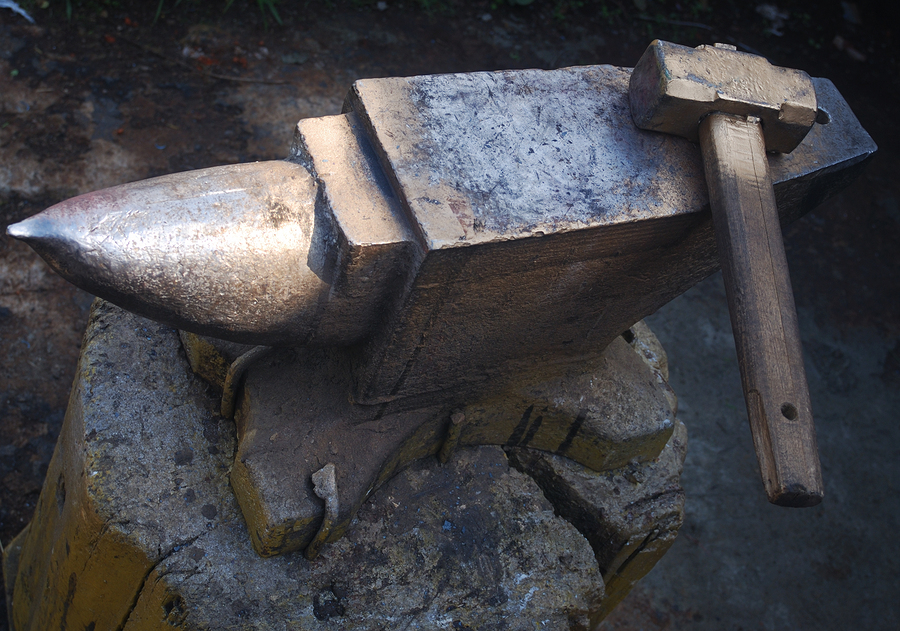
Just Give Me a Hammer

August 3, 2014

Hammer And Anvil

I’ve been writing about the world of independent “indie” publishing for many months. The past few weeks I’ve also had time to review some of those posts, thanks to surgery to repair a massive tear (my doc’s words) in the rotator cuff in my left shoulder.

I have to sleep sitting up (or at least I try to) and I’m up-and-about frequently at night because of the pain and discomfort.

I have to admit, it’s starting to get better … or, perhaps I’m just getting used to it. It still hurts a ton when I move my arm, even slightly, in the wrong direction.

Worse, I’m restricted to an abominable restraint that immobilizes my shoulder, supposedly to keep me from tearing out the anchors they drilled through reconstructed ligaments into the head of my humerus (the big upper arm bone).

I have to wear it for at least another three-to-four weeks and it’s dismally uncomfortable, even without the shoulder pain.

Therefore, I don’t sleep a lot.

Hence, I often find myself re-reading my own posts for something to do as the sun comes up again.

But enough with the blatant sympathy grab …

Like a plethora (I’ve always wanted to be able to work that word into a sentence) of other indie authors, I follow most posts or comments on this marvelous series-of-tubes, inter-webby thing, trying to figure out how to increase sales of my books.

Everything I discover, I pass along to you.

I’ve told you about building yourself a web site, a media page, and about being active on the Book of Face and The Twitter, and the other online social hangouts people use these days to avoid actually having to talk to someone.

Sometimes it all feels like useless effort. I mean, here I’ve got the “Swiss Army Knife” of interactive media going for me and some gangbuster book reviews, and I still can’t break into that space every indie author dreams about … the “Best Seller” list.

Worse, like wearing this shoulder restraint, I feel restricted.

I miss good ol’ conversation … about my books and the books of others. Or just about this whole crazy publishing business. It’s why I enjoy my monthly writers’ group meetings so much.

Another Eureka Moment
I decided I’d better follow the advice of a couple of my own posts for a while. I need to be out there, face-to-face with readers, and talk to them about books and writing … to get them talking to others about my books.

The old “earned media” method … the real hammer of publicity.

So, I just finished contacting my local library about speaking to their reading group patrons (I’m also going to donate some of my books). I’m going to follow-up with additional area libraries and local bookstores, and contact some private area reading groups.

Before schools start getting ready to open again for the fall in about a month, I also intend to be knocking on their doors, asking to present to their senior-level creative writing classes.

Speaking in front of a crowd doesn’t intimidate me (once I get started), and I have a nice Kirkus Review for my “Reichold Street” novel, along with a Readers Favorite Gold Medal and other endorsements as evidence I might have something to say.

As soon as this arm finally heals, I ought to be able to talk to people about writing with enough enthusiasm to create some real interest. I should have a good chance to create some word-of-mouth publicity (the best kind). Enough of this going nowhere with my “Swiss Army Knife” of social media.

Just give me a hammer.


====================

You can find my books as eBooks or paperback on Amazon, or at Barnes & Noble. You’re also invited to visit my web site, BROKEN GLASS, or like my Book of Face page. You can also follow my shorter ramblings on The Twitter.

====================

Comments posted below will be greatly appreciated.

How Do You Write Good Dialogue?

February 24, 2014

boy listening to tin can telephoneThe Secret to Dialogue is Good Listening

Interesting, believable dialogue has been mentioned several times in reviews of my stories. I’m delighted and actually quite proud of that. However, when someone asks me how to do it, there’s only one thing I can say …

Listen
That’s not a joke. If you seriously want to learn the secret to good dialogue, listen to the way people talk … really listen. I do it so much it’s second nature. If you haven’t conciously done it before, take the time to listen to the conversations you hear around you.

Listen to people talking to each other in the check-out line at the grocery store. Eavesdrop on the conversations at other tables in restaurants. Listen to friends talking at social gatherings. Jot down words and phrases.

When you do, the first thing you’ll discover is that no one speaks the way your grade school teacher told you they’re supposed to when she was teaching you grammar (sorry, Mrs. Bliss).

When you listen, it shouldn’t take long to notice the poor grammar, misplaced modifiers, mispronounciatons, sarcasm (both intended and unintended) and allusions that people include in their routine conversations with one another.

You’ll discover believable dialogue is no big secret … it’s just not necessarily proper English.

People get the “poor grammar” and sarcasm part. We all speak in a way that’s less than perfect. It’s when I talk about allusions that most people ask questions. They want to know more about what an allusion is, and how to use it.

It really isn’t hard to describe.

Allusions in Dialogue
An allusion is a reference within your work to another work: a book, a film, a piece of artwork, a known quotation or even a real event. They’re often used to summarize complex ideas in one quick, powerful image, getting your point across without lengthy paragraphs of description.

Think of it as a kind of shorthand that provides greater meaning to what you’re writing about, by relating it to an already familiar story. I often think of allusion as a kind of modern day hypertext, linking the reader to another thought.

There are poems, like T.S. Eliot’s “The Wasteland,” which rely heavily on allusions and practically sample the works of others, the way local bands go through other artists’ songs at a wedding. It’s quite a challenging read (and definitely not one of my favorites).

However, good allusions are contingent on the reader knowing about the story or event being referenced. While they can be an economical way of communicating, you risk alienating anyone who doesn’t recognize the reference … or, as T.S. Eliot did with me … making it so hard to decipher you finally say the hell with it.

As a writer, the absolute last thing you want is for the reader to leave the story.

Allusions in Titles
However, allusions don’t have to be difficult. They can also be quite subtle. For instance, Shakespeare’s influence on English literature is so strong that we often make allusions to his plays without being aware of it.

For instance, these five books give a nod to the bard simply by using his words in their titles.

    “Brave New World” by Aldous Huxley;
    “Something Wicked This Way Comes” by Ray Bradbury;
    “The Sound and the Fury” by William Faulkner;
    “The Gods Themselves” by Isaac Asimov, and
    “The Winter of Our Discontent” by John Steinbeck

Common Dialogue Examples
Good allusions are also found in dialogue. How many times in simple dialogue have you heard something referred to as a “Pandora’s Box?” It’s an allusion to Greek mythology.

The box was actually a large jar given to Pandora which contained all the evils of the world. She was admonished not to open it, but curiosity got the best of her, and all the evil was released when she lifted the lid.

Today the phrase “to open Pandora’s box” is an allusion that means to perform an action that may seem small or innocent, but turns out to have severe and far-reaching consequences.

“I was surprised his nose wasn’t growing like Pinocchio’s.” This is obviously an allusion to “The Adventures of Pinocchio,” written by Carlo Collodi, where the character’s nose grew whenever he told a lie. Even schoolchildren know the story.

“She acted like a Scrooge and refused to buy anything that wasn’t absolutely necessary, and even some things that were.” Scrooge, as most of you know, was an extremely stingy character from Charles Dickens’ “A Christmas Carol.”

Both allusions help cement the writer’s character in our minds without lengthy exposition. We know quite a bit about the writer’s intent for them from one sentence. Both sentences, you will note, are also comments any character might make in simple dialogue.

Thus, allusion doesn’t have to be something that makes reading difficult. It can be found in some of the simplest sentences.

Allusions Are Everywhere
However, the use of allusions is not confined to literature alone. We often refer to common people and places in our speech that are quite apart from scholarly things.

If you pay attention to the conversations going on around you, the occurrence of allusion is fairly common in our daily speech. “Stop acting like my ex-husband please.” That was an actual remark I overheard at a recent social event.

While the reason behind the statement is unknown, the implication of rudeness and distaste in that single sentence tells us a lot about what one character is really saying to another.

Allusion. A useful tool in a writer’s toolbox.