Archive for the ‘Branding’ Category

Should Indie Authors Survey Their Readers?

February 8, 2016

Surveyor
Surveys Can Point Out Better Ways to Go.

Taking a page out of business school (please, bear with me, I like to think the effort to get that MBA years ago was good for something), in my post last week, in addition to a “teaser” from my next book, I included a link to a brief, 5-question survey.

Why? More to the point, why would I use this blog to recommend it to you as an idea?

Well, there are compelling reasons to survey your readers … and the best one is exactly what you might think … to find out where you are.

Understand the Magic
If you’re an indie writer, I’m sure you already know the uphill battle you face to attract readers. One of the best ways to attract them is to write spectacular books.

Another way starts when you use your author platform to discover what they like about you (or, better yet, what they dislike).

Then do something about it.

Author Platform?
You may not have a separate blog started about your writing, but you should at least have a web site. There are numerous good web-site builders, like Site Builder, Web Site Builder, or the one I use … iPage.

There are others, to be sure, but whichever one you choose, make sure you include a way to talk to your readers. Knowing what keeps those readers coming back is one of the secrets to success.

Customer Satisfaction
Satisfied readers are those who don’t have any outstanding negative issues with you. That’s usually because (1) you either write really good stories, or (2) you give them a chance to find out who you are.

Not just as a writer, but as a person.

Your communication needs to let them know what you’re all about. Don’t constantly scream “buy my book” at them. Oh, you can say it, of course. Just don’t let it be the sole reason you say anything.

Let them find out who you really are.

Like admitting you really didn’t watch much of the Super Bowl this past weekend … just looked at the highlights so you could converse with your friends that did.

Oh … and sympathetic listening is essential.

Why the Survey?
The magic that happens when readers start talking about your work and referring it to others is called loyalty. But it must be earned.

You wouldn’t rely on mere “gut feelings” to make important business decisions, would you? You need to base your decisions on objective information. Hence the survey.

If you’re trying to interest someone with your writing (whether it’s a blog like this or a novel), how you go about it is a business decision.

Make it wisely.

So, What Did I Learn?
Unfortunately, only a small portion of readers (a little more than 1%) took the time to visit (and take) the survey but, from those who did, I got some interesting feedback. Most think this blog meets their needs. That, in itself is nice to know.

Things were pretty evenly divided between “leave it alone”“add more podcasts” and “add more writing samples.” I can work on that without changing too much.

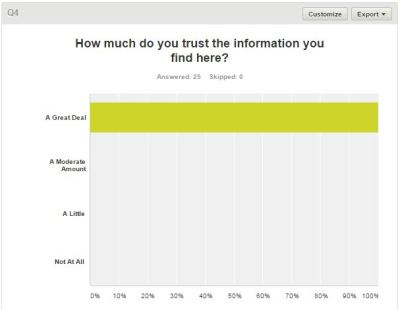
However, in my opinion, the most significant response was to the question about trust. One hundred percent of the answers I received said they trust the information they find here.

All I can say to that is … thanks. I’ll try to keep on earning it.
jan2016 survey


**********

My books have all garnered some terrific reviews, and you can see the ones I have available by using the Amazon link below.

buy now amazon

You’re invited to visit my web site, BROKEN GLASS, or
like my Book of Face page. You can also follow some of my shorter ramblings on The Twitter.

Do You Think Before You Promote?

January 19, 2016

fog

 
Are your promotional efforts sending out an impenetrable fog of Buy, Buy, Buy that no one pays any attention to?

Perhaps it’s because the considerations that matter most in the social platforms indie authors use to promote their work are also the things that should matter most in their personal life.

1. Write More Than You Promote
I think (and this is just me talking … what works for you might be different) that an ideal balance is 80% writing and 20% promoting.

Of course, this assumes you’re not neglecting something even more important along the way … like your family and friends. Make them your priority, and adjust the rest of your time accordingly.

2. Engage, Don’t Spam
In many ways, this is just an extension of point one. Yes, you can talk about your work, but promote in moderation. If the only reason you’re talking to people is to get them to buy your book, most of them are going to ignore you anyway.

Talk to people. Really talk to them. Be a friend and help them. Just like in real life, many of them will reciprocate. It’s amazing how it works … and it’s really that simple.

3. Forget You’re Online
When you engage with others online with your social media, pretend you’re looking right into their eyes. Whether it’s reviewers, readers or other authors, treat them all with the same respect you expect for yourself. Talk about things that interest you, and listen to the interests of others.

The Golden Rule … remember?

4. Pay It Forward
I never get tired of that phrase. I try to pay it forward whenever I can. It’s the main reason I write this blog … to help other indie authors (OK, that’s stretching it just a bit … it’s not the main reason … I do want you to know about my own books, after all).

But I’m convinced positive energy will find more positive energy.

5. Be Prepared to Hear the Truth
When you ask for help, be prepared to hear the truth and react accordingly. No one knows your story as well as you do and, I’m sorry, not everyone is going to be enamored of your heroes. The most helpful of your supporters will tell you when things just don’t ring true.

The key is having people around you who will tell you the truth … even when it isn’t always what you want to hear. They are trying to help, and listening to them will make you a better writer.


**********

My books have all garnered some terrific reviews, and you can see the ones I have available by using the Amazon link below.

buy now amazon

You’re invited to visit my web site, BROKEN GLASS, or
like my Book of Face page. You can also follow some of my shorter ramblings on The Twitter.

**********

Click on the red-arrow link below to hear my recent podcast answering reader questions about indie writing (duration approx 15 minutes):

**********

Comments posted below will be read, greatly appreciated and perhaps even answered.

What the Heck is a Tetrology?

November 12, 2015

slide_208667_680364_hugeMaking a Splash

Now that I’ve written and published three books that are considered a trilogy: (Reichold Street, One Way Street and Street Light) what do I call a fourth book in the series?

This recently became an issue, when I mentioned on social media that I’m writing another book featuring some of the characters originally found in the first three books.

Now, technically, four books in a series is called a tetrology.

Does that mean I have to change the covers for the three books that comprise the original trilogy? Particularly any of them that make reference to a trilogy (like Street Light)?

Well … in a word … probably not.

OK … that’s two words, but authors and publishers have done things like this before. Publish multiple books in a series, I mean.

Some authors have their characters go through changes, and make references to past events (like my series). Typically such series are published in the order of their internal chronology, so that the next book published follows the previous book.

The changes may be minor – characters might get engaged, change jobs, etc. – but it does not affect the main story line.

Besides my books, examples of this type include Tony Hillerman’s award-winning Navajo Tribal Police books.

In other series, the changes are major and the books need to be read in order to be fully enjoyed. Examples of this type include J.K. Rowling’s Harry Potter series.

There are some book series that are not really a proper series at all, but more of a single work so large that it must be published over two or more books.

Examples of this type include The Lord of the Rings volumes (including the prequel, The Hobbit) or the Dark Tower series by Stephen King.

Some authors, like C.S. Lewis, make it difficult to list their books in a numerical order. In his Chronicles of Narnia series, he jumps back in time to early adventures of the characters, writing works that must be placed before or between previously published works.

This was likely done intentionally, as C.S. Lewis was a medieval literature scholar, and knew medieval literature does not always tell a story chronologically.

Now, I’m not using any of this information to make light of those who might question my announcement that I’m working on a fourth book in what they’ve come to know as “a trilogy.”

It’s not something I planned … but neither was the trilogy in the first place. It just happened.

Now, I’ve discovered the characters have more to say … months after I thought they were done.

I’ll find some way to account for it with the title of the new book, which is still up in the air. Hopefully, you’ll just enjoy the read.

Either way, I hope you’ll take a moment to take a short survey about the whole issue.

**********

My books have all garnered some terrific reviews. You can see the stories I have available by using the Amazon link below.

buy now amazon

You’re invited to visit my web site, BROKEN GLASS, or like my Book of Face page. You can also follow my shorter ramblings on The Twitter.

**********

Comments posted below will be read, greatly appreciated and perhaps even answered.