Archive for the ‘Book Promotion’ Category

Writing is Hard

May 3, 2014

Dog Tired
Dog Tired, But The Book Is Done

Believe It Or Not, Writing Is Really Hard Work
It can be so hard you sometimes ask yourself…what’s the point?

For more than 30 years, I woke up before six o’clock, got a cup of coffee, drove an hour to work, sat at my desk (or in my cubicle), and pattered out whatever I needed to do to accomplish the most current assignment.

Meeting results, ad copy, annual reports, public relations blather. When I finished one set, it would be on to the next one.

It’s when I learned what ad infinitum meant.

Then, when everything was done for the day (or I just couldn’t see straight any more) I drove another hour home, arriving too tired to do much of anything.

I’ve been told I did my nine-to-five (or -six, or -eight, or -midnight) quite well. A lot of the ad copy, PR blather and marketing hype won awards…but I would rather have been writing a novel.

However, I had a wife, a house payment, credit card debt and kids, so I needed to make a living. Starving in a garret for the sake of my “art” was out of the question.

So, I had a full-time job (most of the time) and trying to find time to write fiction, which I doubted would ever make me a dime, made me feel selfish.

But I did it anyway.

Writing Fiction
When I did try to write fiction in those early days, I couldn’t concentrate as well as I should have, because I knew at any moment something would interrupt me. My wife. The kids. A broken water heater. We seldom had enough money; the kids needed braces and our old car was always breaking down…but I wrote.

When I finally got something together, usually a short story (for a long time it was the only thing I ever had time to finish) typed out laboriously on my old Smith-Corona, I sometimes had to wait until I could afford manila envelopes and stamps to send it anywhere.

Then I’d wait on pins-and-needles for weeks before I had to deal with the rejection letters…collecting several shoeboxes full of them before I got smart, and pitched the lot of them to get rid of the negative reminders.

Sending out all those queries and stories was more often a chore than anything remotely constituting fun. Toward the end, no one even bothered to send out rejection letters any more. They just didn’t answer you.

But I did it anyway.

Sometimes it felt like trying to separate the Earth from the moon by blowing through a soda straw, and yet I kept working at it. I kept showing up.

I’ve retired from my “make a living” existence, yet I still do it, send out queries and stories…or lately, more likely, indie-publishing the ones I think are the best.

To that end, I finally finished that story I’ve been telling you about for this past year. “One Way Street” – the sequel to my novel “Reichold Street” – is available now on Amazon…finally.

And still I write.

I have a sequel to the sequel in mind.

The Question Is Why?
I have to do it. It’s one of the few real certainties of my life, right up there with knowing my wife truly loves me (why, I sometimes can’t fathom), and it’s exactly why I will, in all likelihood, continue to write. I have to.

As Isaac Asimov, one of my favorite authors, was once quoted as saying, “If my doctor told me I had only six minutes to live, I wouldn’t brood. I’d just type a little faster.”

I understood…exactly…where he was coming from. I write because I have to. Why do writers do that? In all honesty, the point of it all is because there is no alternative.

You are a writer. You show up.

==========

You can find my books on Amazon. You’re also invited to visit my web site, BROKEN GLASS, or like my Facebook page. You can also follow my shorter ramblings on Twitter.

==========

P.S. I participated in another book-signing today, at a local bookstore called the Michigan Book Boutique. To say they were lined-up to get in would be…well…a bald-faced lie.

But I did have the good fortune to share the day with another writer, Keith Faigin. His book is called The Bone Eaters, and if it lives up to its hype “a fast-moving combination of mystery, horror and humor” it should be a great read. I’ll let you know.


Why Walk Away From Your Writing?

March 31, 2014

shoes
Finding My Muse in Montego Bay.

Sometimes the only way you can make progress as a writer is to walk away from it.

Like many authors, I’ve joked about tying myself to my office chair in order to finish a story. After all, like my dear father tried to drum into my head while I was growing up, perseverance is essential to the completion of any project. Isn’t it?

Well … yes.

However, sometimes the determination to never leave your chair can hinder your progress.

The reason for that conundrum lies in how ideas come about.

When you’re stuck in the middle of a manuscript, looking for inspiration, remember the two essential elements for receiving a “light bulb” moment.

1. You Need to Have Done the Work
Your mind needs to have been immersed in the subject, so all the relevant details are already spinning around in your head, and;

2. You Need to Have Walked Away
Relaxing your mind and moving your focus elsewhere allows these swirling possibilities to gradually crystallize into an idea.

Think back to some of your best ideas. Did they happen:

    * While you were in the shower?
    * During a walk?
    * Dozing in church?
    * On your way to work?
    * Just before bed?

What Do These Situations Have in Common?
For one thing, you’re not in front of your computer staring at a blank page. They’re moments when your mind was distracted by other things.

Meanwhile, in your subconscious, elements you may never have consciously associated with one another coalesce to form the solution to your problem.

Naturally, you can’t spend all your time wandering about the house or standing in the shower, hoping every element of your story will magically appear in your head.

So when should you walk away from your writing and when should you stay? Try this handy checklist:

Freewriting
Our fear of the blank page often stops us from writing, even if the words are ready to come. Freewriting, or stream-of-consciousness writing, forces you to get words out just to get your flow started. The key is not to get caught up in perfectionism. Try literally forcing the words out, even if they’re rubbish.

Stay On Track
Sometimes a writing block is caused by an earlier wrong turn we’ve taken … perhaps a spot where we forced a character to do or say something that just didn’t fit. Read back over your manuscript to see if there was a point where your prose became labored. If you find it, try starting fresh from that point.

Character Profiling
If the words aren’t coming easily, perhaps it’s because the world of your story, or the characters who inhabit that world, are not yet well defined. Instead of trying to add to your word count, spend your writing session trying to better describe your world or interviewing a character.

Limit the Time You Stare at a Blank Page
Past a certain point, perhaps 30 minutes, simply gluing your butt to the chair just doesn’t cut it anymore. If you’ve been doing all of the above and you’re still no further along, trust me, you’re ready to walk away.

How Long Should You Leave?
Sometimes a few minutes will provide enough release to bring the rush of ideas. You might be surprised how quickly the words return.

If that doesn’t work, you may need to leave your writing for more than that … even for a day or two. I did just that, thanks to a generous invitation from my son and his family to join them in Jamaica for a week.

You may remember I’ve talked about my REICHOLD STREET sequel being stalled now for more than a month. My “thousand words a day” mantra had become hopelessly bogged down. Ideas just wouldn’t come. I tried stimulating my brain with every hackneyed piece of writing advice I’d ever heard.

Nothing worked.

So, when that generous invitation came from my son, I walked away from my writing. I even did the unthinkable: I left my laptop at home in Michigan (the craving only lasted about a day).

Great Advice
One of the surprises, at least for me, of finishing my first novel was discovering just how many of the most hackneyed pieces of writing advice actually turn out to be true.

For example: nearly every author interview will include some reference to how important it is to just sit down in the chair … meaning, the best way to get writing done is simply to sit down and get it done (Hemingway famously said “There’s nothing to writing … you simply sit down at the typewriter and bleed.”)

And then there’s the best piece of writing advice I’ve actually ever received (even better than Anton Chekov’s “Show, don’t tell”). You’ve probably heard it before:

Write the book you want to read.

I know what you’re thinking … of course, that makes sense, but why bring it up? Because it’s easy to confuse this advice with a very similar, and very bad, piece of advice: Write the book you want to write.

Here’s the Important Distinction:
The book you want to write is the book that, in your fantasies, you’re autographing at your overcrowded book signings and seeing projected across the back of the stage when you win every literary prize available. That’s the book you want to write.

The book you want to read, by contrast, is the book you’d curl up with if you knew you’d be spending time in, say, some tropical island somewhere … like Jamaica. It’s the book you can lose yourself in … then stash on the shelf, dog-eared and half-destroyed, only to pull out every year to read all over again. That’s the book you want to read.

And the latter is really the book you should be striving to write. Write to entertain. Forget the awards. If your book is worthy, they’ll come. But I’d much rather have a host of happy readers.

I walked away from my writing … completely … for more than a week. Now that I’m home again, I’m delighted to also be writing again. Another 6,000 words. Good ones … all of them keepers … in the last five days.

I found the muse again by walking away, and when I’m done with One Way Street, I know it will be a book I, and hopefully others, will want to read.

Are In-Person Events Worth the Time and Effort?

February 14, 2014

Portrait-Boy-Microphone

Social Meetings or Social Media?
I’ve had this particular blog since 2006, but it was originally to talk about my camera-collecting and photography. I was content with a few photography friends and family as followers.

At the suggestion of my son, Jeff (an accomplished architectural photographer), I began my adventure using social media to talk about the world of indie publishing and to promote my books. I also created a writer’s page on the Book of Face, and started making those ultra-short speeches on The Twitter.

It all sounded like a good idea at the time, for two reasons:
   1.) I didn’t know any better, and;
   2.) It fit in my promotion budget, which was exactly zero.

Instead of pursuing any speaking engagements or book signings, I spent my time focused on social media. Book sales went nowhere.

When my first book, REICHOLD STREET, was published, I mentioned it to a small group at a monthly writer’s group meeting I attend. Those monthly meetings were, for a long time, the only in-person interaction I had with any potential readers (and it was mostly the same people at each meeting).

Not much word-of-mouth going on.

The Power of Earned Media
It got me thinking that maybe I shouldn’t be so quick to ignore the old-fashioned “dog-and-pony show” authors have used for years to build an audience. It’s called “earned media,” and I’ve mentioned it before, so I won’t bore you with it again.

All you need to remember is it’s not something you actually pay for, because it’s essentially word-of-mouth. But that’s the beauty of it. It’s only real expense is your time.

To gather earned media all you need to do is get off your duff and talk to people. In other words, do something that gets you noticed, even if its only a little at a time, because you need others to create the buzz for you.

Of course, you could always choose to gather immediate name recognition for yourself by running naked through the nearest mall, holding up a sign with your name on it, shouting “Look at me, I’m an author!” and then post the resulting video … along with the shots of you getting arrested … on YouTube.

But I’m not going to speculate on how many books you might sell if you actually did it.

With In-Person Appearances, It’s All About Quality
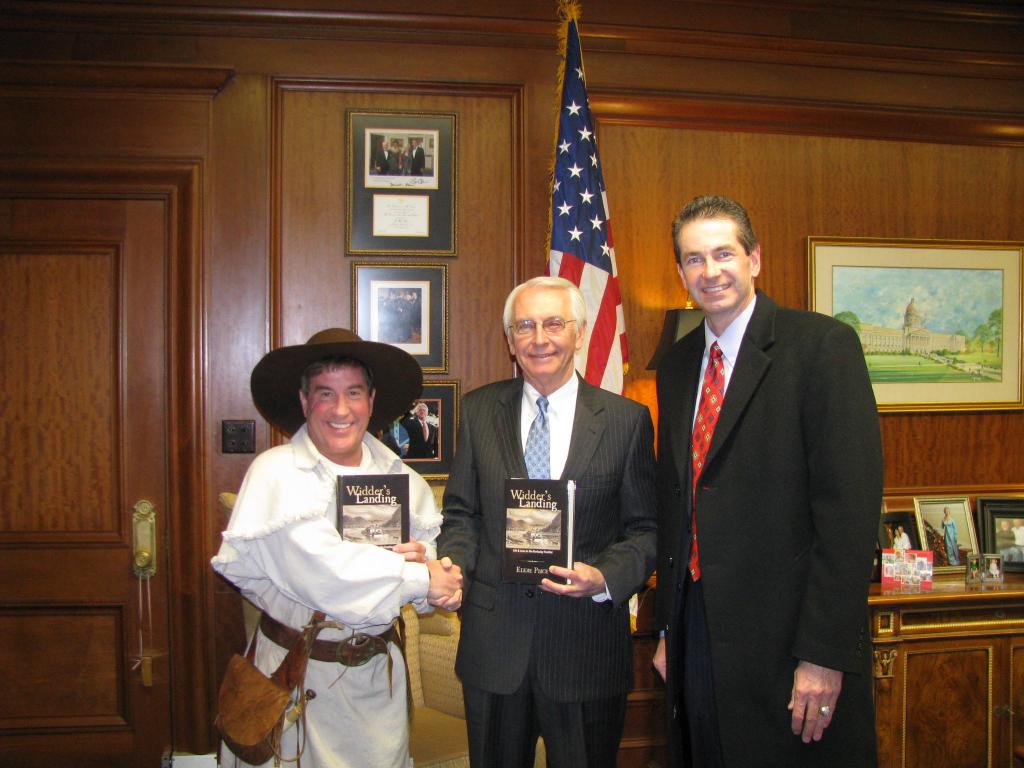
I had a discussion about earned media (although we didn’t call it that) with self-published historical fiction author Eddie Price.

Eddie (below left, with Kentucky Governor Steven Beshear and Keith Steele, President of Acclaim Press) spoke at the Readers Favorite Awards Ceremony last November, and I was impressed by how hard he worked to build his audience.

eddie price

Ed’s book “Widders Landing” (the 2013 Readers Favorite Gold Medal winner for historical fiction), begins in the years just prior to the War of 1812. Eddie said he would often show up at libraries, schools and other events dressed in period costume.

He also joined historic battle re-enactment groups, where he found a built-in audience for his genre of fiction. He knows there’s something special about meeting an author in person, hearing him speak and getting a book signed. A connection is formed that puts a human face on the book that makes it memorable and there’s a good chance people you meet will become fans, buy your book (and your future books) and tell their friends about the experience.

Eddie’s sales figures are pretty good, and he mentioned he’s visited just about every county in his home state of Kentucky. The real kicker is, on top of it all, he’s having fun.

Continue reading the rest of this post>