Posts Tagged ‘self-publishing’

The One Best Storytelling Tip

February 7, 2013

“Encourage Everyone You Know to Read”

The very best tip I’ve ever seen for good storytelling is something I wholeheartedly believe to be true. If you want to be a good writer and storyteller … read.

I saw that admonition again most recently in my fourth time through “On Writing” by Stephen King.

Read.

Such a simple, profound thing. Don’t limit yourself. Open up your world. Read everything you can lay your hands on. Whether you want to write thrillers, fantasy, science fiction, suspense, romance or action/adventure; before you do anything else … read.

I believe in that advice. I’ve always been an avid reader. I encouraged my sons with it and, now that they’re grown, I’m delighted to see it passed on to my grandchildren. Read.

When they’re too young to read for themselves, read stories to them. The small effort it takes will pay enormous dividends.

Write Like You Read
When it comes to writing, we’ve all seen structural articles galore where professors, “experts” and pundits tell you to outline your plot. Introduce your main characters and themes in the first third of the story. Develop those themes and characters in the second; then resolve it all in the rest.

Really? Those writers had to get advanced degrees to tell us to write a story that people would actually want to read?

Michael Moorcock is one of the more dazzling science fiction writers of our time, having written dozens of novels and short stories since the very early 1960s.

He claims to have followed such a scripted approach and, as I said, he’s a phenomenal story teller. I’ve enjoyed his work immensely.

But when I read his idea of how to go about writing is very like that rigid structure mentioned above, it was a letdown (sorry, Michael).

As his wide audience of fans will attest (and I am one), the man knows how to tell a good story.

That approach to writing, however, if you will pardon me for a moment of brutally honest opinion … is academic bullshit.

I’m much more a follower of Stephen King’s method (see my earlier post). I start with an intriguing what-if? question, then try to visualize what happens. I let the story come to me, then translate what I see and hear in my mind into words on the page.

I suppose, by doing that, I’m ignoring all the proferred rules, regulations, templates and I-told-you-so guidelines and creating my own, suitable for what I want to say.

I’d encourage you to try it, too. At least once.

Of course, if you’re more comfortable with notes and outlines and rigid structure; go for it. It seemed to work for Michael Moorcock, and my own Mrs. Bliss, bless her, if she were still around, would give you bonus points on your report card.

Perhaps the real method is to read good stories, absorb … and repeat. Create your own storytelling process, and judge by the rapt attention of your readers and listeners how it’s working.

Like I mentioned before, it’s the final story that counts … not how you got there.

If you have a moment, please watch the book trailer for REICHOLD STREET.


Storytelling

January 23, 2013

boat“Old Boat” Photo © Bern Altman

“That catfish was so dang big it took three growed men and a boy to haul it into the boat. Durned near broke my pole, it did. And when it realized I weren’t about to give up, it headed for all that brush on the near shore, tryin’ to snap the line.

But I played him out along the bank, and kept him out of the weeds and the fell trees until I thought he was plumb tuckered out. It still took me and Clem and Luther, and little Andy, too, to haul him outta that muddy brown water and hold him on the boat bottom. He put up a thrashin’ that liked to break my arm.”

Storytelling sets a rhythm in motion that encourages readers to finish what they started. Good stories enchant their readers.

I think I’ve done it correctly in my books. I always try to imagine the reader sitting directly across from me as I tell the story. And I try to do it in simple, direct, compelling language, like my grandfather used to do with his fish tales.

When I write my own stories I try to talk to the reader as if I were speaking to one of my best friends. Reviewers have said it works. But storytelling and vulnerability don’t always come easily when translated into a blog like this one … even though I’m trying to talk to you as if you were one of my best friends, too.

Have you ever asked yourself why a specific blog post stopped you dead in your tracks? I have. I’ve read posts that were so captivating that I laughed out loud, or shed a tear. I’m willing to bet you have too.

If you think about it, like I’ve been doing lately, there are patterns at play in those great posts. Patterns that I’m afraid I’ve often ignored. You’ve probably read some of my posts that totally missed the mark, or left you yawning. There have been a bunch of them.

The ones that work, at least for me, are the ones where I’ve opened up with something personal. In a way, when you do that it makes you vulnerable. But when you’re most vulnerable, you tell your story wholeheartedly and honestly. The connections you make between yourself and the reader are authentic.

That kind of connectedness is what human beings are all about. It’s what writers are all about, too … or at least they should be.

For those of you who blog because you are also authors – particularly self-published authors – take a close look at the posts you think are captivating.

I think you’ll find it’s because those writers tell their story without holding anything back. The authors are truly vulnerable to the audience and tell a vivid, compelling tale with a willingness to be transparent, as they would with a friend.

I try to remind myself of two things when I write this blog. I can either write content that is dry and safe, with no personality; or I can write something daring and transparent that will shake the floor beneath the reader’s feet. At the very least I should bring back a sweet memory of something that was special in their life, too.

Good storytelling is a skill that’s only mastered by doing it relentlessly. Once mastered, all you need to do is use it.

Now that you’ve come this far, won’t you please check out my book trailer?


Self-Publishers: Concentrate on Content

January 19, 2013

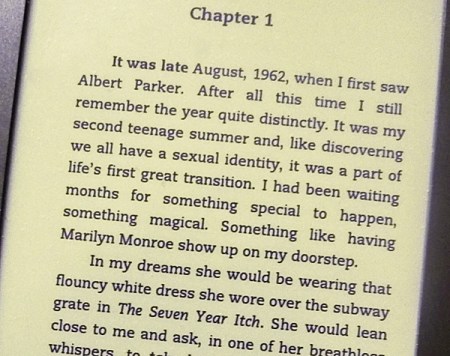
newest kindle pic“Reichold Street” on the Kindle  © R.L. Herron

A Good Time for Publishing
According to Jon Fine, the Director of Author and Publisher Relations at Amazon, the sky is not falling for traditional print books. Yes, sales of e-Books are going up … but so are sales of printed books. The digital revolution is causing everyone to read more – and that’s good news for everyone involved in publishing.

But little has changed, regardless of format, when it comes to getting your self-published book discovered.

There are many more ways now to accomplish self-publishing a book, but it still means you, as both the author and publisher, need to answer the reader’s ultimate question: “What’s in it for me?”

If you fail to answer that question you probably miss making a sale and, worse, you’ll have lost even the potential for word-of-mouth conversations about it … at least any good ones. There’s just too much good competition out there.

Why is That Important?
A recent Bowker.com survey of book buyers found that most readers discover new books in this order:

    A. An In-Person Friend Referral

    B. A Retail Store Display

    C. A Visit to an Author Web Site or Blog

    D. A Review of Bestseller Lists

The statistics tell the story. All things considered, word-of-mouth is the number one book-discovery source.

Let’s face it. the chances of getting your local bookseller to put up a retail display for your self-published book are pretty small.

It took a lot of convincing (and a signed copy of my book) to get the manager of a local bookstore just to agree to put some of my rack cards on his customer service counter.

A personal web site or a well-written blog may ultimately be the best ways for people to find you. But, you still need to get more than just your friends, neighbors, siblings and a few friendly cousins to visit.

And even if you do, once they’ve been there, you need to give them a reason to come back.

Of course, if you should make the best-seller lists that issue becomes moot. But in order to break into that list both you and your book need to be discovered.

Nuts. Back to ground zero.

How Do I Assure MY Book Gets Discovered?
Ah, that’s the real question, isn’t it?

Obviously, you need to make it easy for people to want to tell their friends about you. That’s the ticket.

And how do you do that? By writing something informative, or funny, or just plain interesting. Just as in writing your book in the first place, content is the king in this discussion. You have to be interesting to convince people your book might be.

I thought about offering a video-chat as a way to speak directly to potential readers and get their ideas, like Stephen King did to promote his book “Full Dark No Stars.”

If you’re woefully behind, like me, on how to actually do something like that, it becomes a problem. Of course, as you might imagine, if you’re not already famous the problem multiplies.

You still need to have something interesting to say once you’re “live.”

Then there’s the publicity effort it must take to interest thousands of people on the idea of vying for the opportunity to participate in the first place. Stephen King probably had no problem. Me? … it just ain’t gonna happen.

That’s despite all you wonderful folks who already follow this blog.

Getting Known
So, there’s still the problem of getting enough people to know and care enough about what you have to say to visit regularly … and then spread the word.

I recently read “experts” from other self-publishing blogs suggest that if you have a WordPress blog, like this one, you should go to places like Yoast.com and get the plug-ins they provide for enhanced search engine optimization to make yourself a known commodity.

That may be a good thing. In fact, I’m sure it is. Search engines do find what you search for. Sort of.

But something tells me the best search engines are only going to find you and your book, if both you and your book are worth finding.

Your metadata may be optimized … but every one of those “experts” I read failed to mention that people will only bookmark and return to sites that inform or entertain them.

Remember: Content
I recently had a decision to make. The growth of followers for my blog has leveled off. So have sales of my books.

I could figure out what was wrong, or continue doing what one of my sons accused me of doing with some of my earlier social media efforts: Stand on the corner and shout “Buy my book!”

I’ve already discovered that kind of marketing doesn’t work. Thank you, son. Message received. You were right on. Content is everything.

People don’t buy what you do. They buy why you do it.

So the best option is to write a good book and then have something sincere and interesting to say.

I wrote an award-winning book. Now I have to prove I have something to say that’s worth reading, and it really doesn’t have to be about my books. In fact, it shouldn’t be.

It has to be about me, and who I am.

I’m working on it.

If you have one more minute, please check out my “Reichold Street” book trailer: