Posts Tagged ‘indie writers’

How Should an Indie Writer Market?

October 1, 2015

drawing marketing concepts
Exciting the Crowd is Important

Every indie writer must also think about marketing. It’s a given, I’m sad to say, when talking about independent publishing. Even if you don’t like to do it. Marketing is crucial to your success.

But every indie soon learns self-promotion is a tricky balancing act. There’s a very slim line between effective self-promotion and simply being annoying.

If you’ve ever seen those who Tweet “Buy My Book” three-hundred and twenty-two times a day, you know what I mean.

So How Do You Do It?
Building a platform takes time. And, before you ask…yes, you need one, even though constructing it can devour a great deal of the day you’d rather devout to writing.

Once you’ve constructed it, you need to remember there’s no secret formula to building a following. It’s not as simple as build it and they will come. It takes time.

You may promote with the skill of a master, but even a DaVinci would need to understand how much luck will play a part. Your information needs to be seen by the right people, at the right time.

But it’s got to be more than that.

Social Media is Just That…Social
One of the ironies of the writing life is that many authors are introverts. Most of them are people who find it hard to morph into an extrovert in order to promote their wares.

For instance, one of the recommendations I’ve seen (but haven’t tried yet) is to give one of my own recurring characters a Twitter account of his/her own and let them comment on the events in their lives.

Who knows? It might even lead to some yet unknown story ideas.

But I’m not sure that’s what it’s all about. I think you need to talk to people. Not just should talk to them…you need to. Talk to them on your web site, blog, on the Twitter, and even on The Book of Face.

What do you talk about? If you follow my blog here you know I write about indie publishing and I try to pass along whatever I learn.

What else? Well, along the way I discovered that many non-writers (and, surprisingly, some other authors) are actually curious about the so-called Secret World of the writer.

How do we go about it? Where do we get our ideas? Why do we write?

If these are important questions being asked, why not make answers to some of those questions a feature of your own marketing?

Why not indeed.

I decided if answering questions isn’t being social, what is?

My Podcast
As I promised some time ago, I opened up to audience questions, and many of you were kind enough to provide them. I always intended to share my answers with you, more or less live. It’s taken some time, but the podcast is here.

Click on the red-arrow link below to hear me answer your questions about indie writing (duration approx 15 minutes):

**********

My books have all garnered some terrific reviews. You can see the stories I have available by using the Amazon link below.

buy now amazon

You’re also invited to visit my web site, BROKEN GLASS, or like my Book of Face page. You can also follow my shorter ramblings on The Twitter.

**********

Comments posted below will be read, greatly appreciated and perhaps even answered.

What’s in a Book’s Elevator Pitch?

July 31, 2015

elevator2An Elevator Ride Doesn’t Last Very Long

Every author has been in the position where someone asks them to describe his/her book. It happened to me several times at a book-signing last Saturday (although, if you read my previous blog post, it didn’t happen as often as I hoped it would).

What’s your book about?

The answer you give to that question is called an “elevator pitch.”

The term itself comes from the scenario of an accidental meeting with someone important. It’s any quick, catchy pitch you can deliver in the short time it takes for an elevator to reach its destination.

I’m sure you’ve heard the term before. I didn’t invent it. It’s been around the business world for decades. Now, however, as an indie author you need to think about it in terms of your new book.

By preparing an elevator pitch in advance for your book, you’re ready for whenever (and wherever) the question comes up.

Step 1
Decide on the goal of your pitch. Do you want the listener to visit your website? Look you up on Amazon? Choose what you want your pitch to convince the listener to do.

Remember, you’re probably not going to make a book sale right there in the elevator. Focus on what you want the listener’s next step to be.

Step 2
Brainstorm potential openings. You want something attention-grabbing that will hold the listener’s attention for the whole pitch.

Step 3
Every pitch is unique, but some of the questions your pitch can answer include:

    – What is your book about?
    – Is there a genre or author you can compare your work to?
    – Have you received any awards or glowing reviews?

Write a 20-30 second pitch (any shorter and you’ll sound like an ad; any longer and you’ll lose the listener). Keep your goal in mind! Focus on being compelling and intriguing.

Step 4
Decide on a closing line. Make it an active call to action. It can be something as simple as, “Does it sound like something you’d be interested in?” This is the final step in guiding the listener toward your goal (remember Step #1?).

Step 5
Edit your pitch. Focus on removing unnecessary words and making it sound natural. Read it out loud and be sure it’s in your natural speaking voice, not your writing voice! Make doubly sure it is clearly directed toward your goal.

Step 6
Make your pitch work even harder by always carrying a business card or bookmark with information about you and your book (I make my business cards with Vistaprint).

Your pitch probably won’t be perfect the first time you use it. Every time you give it, however, you can refine it and make it more effective. Practice on friends and family first (my long-suffering wife gets to hear all of mine).

She gives me feedback I may not have thought of and the practice helps work out any jitters BEFORE I have that chance meeting with the local television news celebrity in the elevator.

My Elevator Speech for Reichold Street:
“REICHOLD STREET is a young-adult coming-of-age thriller about teenagers growing up in the Vietnam era of the 1960s. It deals with real life, and things like family dysfunction, bullying, alcoholism, madness and war. Tough issues. It was favorably reviewed by Kirkus Reviews and received a 2012 Readers Favorite Gold Medal.

Does it sound like something you might like?

Visit my website (ronaldherron.com) and you’ll learn all about it … and get to see my other books, too.”
 

**********

The Official Book Trailer for “Reichold Street”

New reviews are in for my latest novel, “Street Light.” One is from Top Book Reviewers and the other is posted by Readers Favorite. I’ll let them speak for themselves.

**********

My books have garnered some terrific reviews. You can see the stories I have available by using the Amazon link below.

buy now amazon

You’re also invited to visit my web site, BROKEN GLASS, or like my Book of Face page. You can also follow my shorter ramblings on The Twitter.

**********

Comments posted below will be read, greatly appreciated and perhaps even answered.
What is the Science of Writing?

June 30, 2015

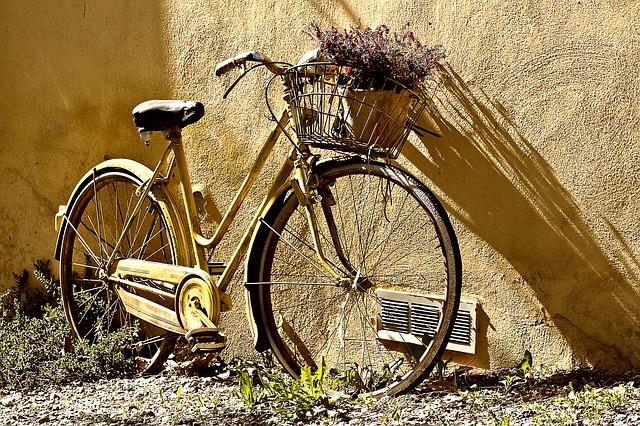
old bike
Flowers in the Basket

I’ve said it before. Good writing is part science and part gift. The gift part is something only a lucky few are born with.

There are only so many Stephen King’s, J.K. Rowling’s, Brad Meltzer’s or James Patterson’s, after all.

The science part is something everyone can do. It’s called reading.

This bears repeating. Good writers have to read. Have to. Because reading the works of other people is studying the craft.

Without that study, a writer will never possess more than a small piece of the puzzle.

So, if you want to be an author (a good one anyway), you have to read everything you can. No way around it.

Some people think it’s easy. After all, everyone writes.

We’ve all been doing it since our earliest school days. Right after learning the symbols of the alphabet and the sounds those curious scribbles stood for, we began to create words.

Most of us at least wrote stories and essays in school.

A few people write or comment on a blog (the Journal of today), and most exchange emails with friends and neighbors, even if they don’t write letters anymore.

At the very least, a lot of us have scribbled 140 characters or less into a thought of some sort on The Twitter.

Real authors, however, create wings for their thoughts. Writers … good ones anyway … create worlds, shape ideas and make us think.

Words are never more alive than this.

I love working with words.

I try to sculpt ordinary words until they shine, putting something out into the universe that never existed in quite that way before. I’m not quite vain enough to think I have a natural ability for the craft.

I know success only comes with practice, so I work hard at it … every single day.

Even while I was vacationing last week with some dear friends, I was reading … and imagining how I could describe the things around me. The clouds. The sea. New people and places.

I was also thinking about that podcast I promised to make, answering your questions about writing. Hang in there. It’s coming.


**********

My books have garnered some terrific reviews. You can see the stories I have available by using the Amazon link below.

buy now amazon

You’re also invited to visit my web site, BROKEN GLASS, or like my Book of Face page. You can also follow my shorter ramblings on The Twitter.

**********

Comments posted below will be read, greatly appreciated and perhaps even answered.