Posts Tagged ‘indie writers’

Why Writers Write

September 5, 2014

In The Fog

I’ve had a lot of time lately to think and read. Can’t do much else. Doc says I tore ligaments right off the bone in my shoulder … it’s one of the worst repairs he’s had to make.

Whoopee. Not exactly the way I wanted to enter the record book.

Surgery was weeks ago, but I’m finally able to get out of the restrictive sling that immobilized my arm and into rehabilitation therapy … where they tell me it will be six months to a year before things return to normal.

Word of advice. Don’t tear your rotator cuff. There’s a reason pro ball players often don’t return from this injury. It’s a long and damned painful rehabilitation.

Oh, I know there are a lot worse things that could happen … and I’m grateful they didn’t, so I try not to complain. But, just so you know, my bride says I’m not very successful at it.

What really bums me the most, I wanted to finish the third book of my REICHOLD STREET trilogy this year, but I may not make it. I’ve only written about six thousand words and my writing has been slowed to a crawl.

On the good side, I’ve discovered I can hunt-and-peck with one hand on the keyboard … so I blog. Doing it this way (peck, peck, peck), at least I have a lot of time to think.

I Like What I Do
I like being a writer. Human beings are born to communicate and make connections. Words give us the means to reflect upon and interpret the world around us, and to share our interpretation of the world with others.

As babies we imitated the sounds we heard in the language of those around us. We delighted in repeating them and seeing recognition in the eyes of listeners.

As artists, and especially as writers, we long to recapture the enthusiasm of childhood. I know I do. Authors use words to bring thoughts to life on the page, and I find that exciting.

Stephen King once said, Words create sentences; sentences create paragraphs; and sometimes paragraphs quicken and begin to breathe.

And while today most of us have exchanged pen and paper for the computer screen, we still use the words we learned as children to express our emotions.

In those ancient days before electronic communication (or even typewriters) an author wrote with a pen, one letter at a time, with cursive letters (do they still teach that?) joining and blooming into a word, each word helping to shape the sentence structure.

How you wrote, and what you wrote about, were uniquely your own. But you wrote.

Everyone Writes
Everyone writes. Think about it. We all create with words, spoken or written. Most of us have written stories and essays in school, kept a journal, written or commented on a blog, composed a business letter, or exchanged emails with our neighbors.

Authors, however, try to create wings for their thoughts, releasing them to reflect the life stories around them … and shape the thoughts echoed in everyone’s soul.

Words are never more alive than this.

Writers … good ones anyway … can create worlds. Through the process of their writing we discover their stories are true, even though we know they’re fiction, because they reflect a universe in which we are all inexplicably linked to everything around us.

For some, writing is redemption. They sculpt ordinary words until they shine, putting out into the universe something that has never existed before, tales that delight or entertain or inform.

Just like everything else in life, there are those with a natural ability for the craft, but the ones who succeed also make room for the practice involved. That’s right … practice.

Good writing is part science and part gift. The gift part is something a lucky few are born with. The science part is called reading. Reading the works of other people who wrote the books you wish you had written … that is studying the craft.

Without that study, a writer only possesses a small piece of the puzzle. Good writers have to read. Have to.

Writers seem to know by intuition that somewhere in the gray fog of the world there are words with their name on them, imprisoned like a fairy-tale princess, waiting to be released.

I like to believe that’s true.

To be a writer, your task is to to discover them and share them with the world. No one else can do it for you.

For now, I’ll do my prescribed exercises getting ready for rehab again in the morning. Then I’ll read a bit, to get tuned-up.

Tomorrow, it’s back to work.


====================

You can find my books as eBooks or paperback on Amazon, or at Barnes & Noble. You’re also invited to visit my web site, BROKEN GLASS, or like my Book of Face page. You can also follow my shorter ramblings on The Twitter. You might even decide to read my Kirkus Review.

====================

Do You Know The Secret Truth About Writing?

August 21, 2014

Break On Hammock

Another writing blogger, whose scribblings I often enjoy, pointed out in one of his musings a while back that with all the articles, novels, e-books and blogs available today, more words are being written now than ever before.

As he also pointed out, a lot of that writing can be summed up in one word … forgettable.

Sadly, I agree with him.

I’ve seen a lot of things written by the new surge of independent, self-published authors that are not only forgettable, they’re often trite, badly formatted, poorly written and downright boring.

I suppose that’s why my local library didn’t want my books in their collection when I first asked if I could donate them.

Two of the four books are award-winners. All have received 5-Star reviews. But folks at the library hadn’t read a single word, and they were adamant in wanting nothing to do with them.

They said “no” because I was an indie author, and that … at least in their minds … put me in that nefarious one-word category where they dump the work of a lot of indie authors:

Bad.

Looking For a Reason
I don’t blame the library for their early reluctance. Unfortunately, a lot of the writing being done by indie authors is just plain terrible, and they had no reason to believe otherwise about mine.

That is, not until Kirkus Reviews … a venue they both know and respect … had good things to say about my novel.

I’m happy to say the library has now accepted my donation. I’ve even registered for their Local Author Fair this fall … a venue where they ask authors to come, sign some books and promote the library.

It started me thinking. A lot of writing by non-traditional authors is bad. Not all of it, but enough to leave that kind of sour, negative impression of anything related to indie … even with the explosion of non-traditional publishing in recent years.

Why is that?

OK … it’s just my opinion, but I think it goes deeper than not having a cadre of editors to fix things. I think too many indies are still trying to follow the simplistic rules laid down to them as gospel when they were in school. Rules dictated by instructors who never came close to having a best-seller to brag about.

They listen to the kind of pablum that continues to be handed-out, or worse … sold … in writing classes and the myriad writing publications, but their work doesn’t get any better.

Why?

To Write You Have To Read
I believe it’s primarily because they never actually read the works they admire, and reading is the key.

I don’t mean just reading the words. I mean reading the story again-and-again to understand, at an intrinsic level, why it works. To get stronger as a writer that kind of analysis is crucial.

Why does the dialogue seem like real conversation? How does the author’s description evoke a reaction from all your senses? Why do you find the main protagonist, or any of the characters at all, memorable? How did the author actually make you see the scene?

Conversely, if the story was bad, why was it bad? Where, exactly, did it fall apart?

Most writer wannabes never read stories like that … with the intention of finding out why they admire them. If they did, they would discover the great secret truth about writing. Pretty words and grammatically correct sentences don’t mean a thing.

It’s All About Storytelling
Storytelling is the secret truth about good fiction writing. It’s never been about pretty words and grammar (sorry again, Mrs. Bliss, but it’s true) … because no matter how perfect the body looks, it’s the engine under the hood that makes the car move.

That’s not to say you don’t need to understand grammar and spelling and proper formatting. You most certainly do. However, most of what they teach you in school, or in books on writing, could be summed up quite simply as bodywork.

It’s all right, as far as it goes … but I’m telling you here and now it doesn’t matter how pretty the car looks (or how perfect your sentences are). The vehicle may seem pretty, but if the engine just doesn’t work you’re not going anywhere.

Good storytelling is the engine of good writing.

I’ll say it again, because it’s the most important thing you can learn as a writer. It’s the storytelling that matters most.

People like a story that makes them laugh or makes them cry, that thrills them … or scares them out of their minds. People want to FEEL something when they read your stories. If the engine doesn’t work, your readers aren’t going anywhere with you. In fact, they may never travel in one of your stories again.

It’s why I enjoy reading Stephen King. Some people don’t like the genre in which he writes, but in every case, even in the few stories I really don’t care for myself, his writing clearly displays his most wonderful skill: HE KNOWS HOW TO TELL A DAMN STORY.

If you want to write, learn to pay attention to things like that. It’s not easy. For some, it may be the hardest thing you do.

Don’t get me wrong. Writing doesn’t have to be painful. Writing should be fun, and it should be magical … for the person banging on the keyboard and for the people who read it.

With a bit of luck, and the concerted effort it takes to read and analyze the things you like, your own writing can discover the magic. It’s the “concerted effort” part that brings dismay, and some degree of hesitation, to many … but it does pay off and I guarantee you’ll have a smile on your face when it does.

Better yet, so will your readers.


Just Give Me a Hammer

August 3, 2014

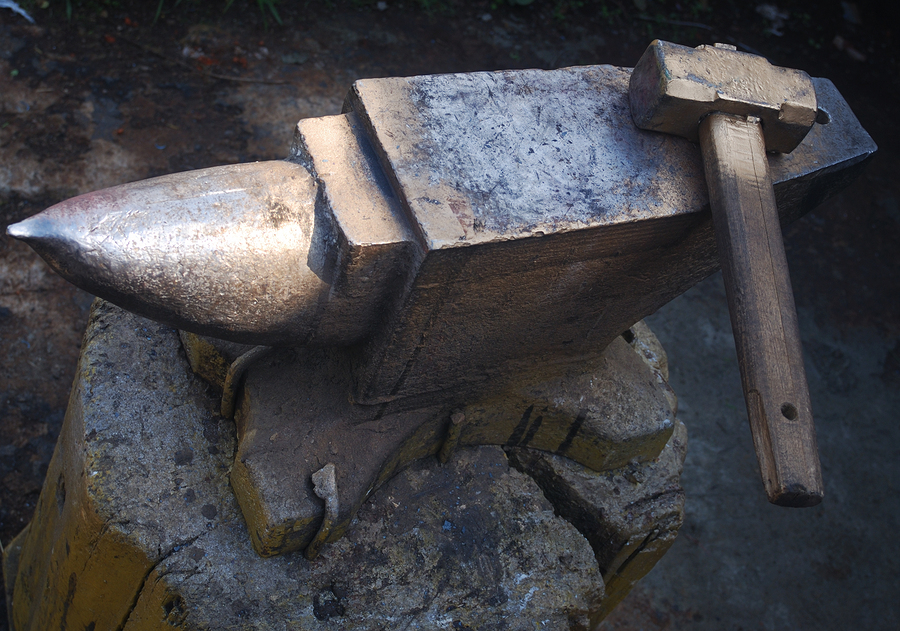
Hammer And Anvil

I’ve been writing about the world of independent “indie” publishing for many months. The past few weeks I’ve also had time to review some of those posts, thanks to surgery to repair a massive tear (my doc’s words) in the rotator cuff in my left shoulder.

I have to sleep sitting up (or at least I try to) and I’m up-and-about frequently at night because of the pain and discomfort.

I have to admit, it’s starting to get better … or, perhaps I’m just getting used to it. It still hurts a ton when I move my arm, even slightly, in the wrong direction.

Worse, I’m restricted to an abominable restraint that immobilizes my shoulder, supposedly to keep me from tearing out the anchors they drilled through reconstructed ligaments into the head of my humerus (the big upper arm bone).

I have to wear it for at least another three-to-four weeks and it’s dismally uncomfortable, even without the shoulder pain.

Therefore, I don’t sleep a lot.

Hence, I often find myself re-reading my own posts for something to do as the sun comes up again.

But enough with the blatant sympathy grab …

Like a plethora (I’ve always wanted to be able to work that word into a sentence) of other indie authors, I follow most posts or comments on this marvelous series-of-tubes, inter-webby thing, trying to figure out how to increase sales of my books.

Everything I discover, I pass along to you.

I’ve told you about building yourself a web site, a media page, and about being active on the Book of Face and The Twitter, and the other online social hangouts people use these days to avoid actually having to talk to someone.

Sometimes it all feels like useless effort. I mean, here I’ve got the “Swiss Army Knife” of interactive media going for me and some gangbuster book reviews, and I still can’t break into that space every indie author dreams about … the “Best Seller” list.

Worse, like wearing this shoulder restraint, I feel restricted.

I miss good ol’ conversation … about my books and the books of others. Or just about this whole crazy publishing business. It’s why I enjoy my monthly writers’ group meetings so much.

Another Eureka Moment
I decided I’d better follow the advice of a couple of my own posts for a while. I need to be out there, face-to-face with readers, and talk to them about books and writing … to get them talking to others about my books.

The old “earned media” method … the real hammer of publicity.

So, I just finished contacting my local library about speaking to their reading group patrons (I’m also going to donate some of my books). I’m going to follow-up with additional area libraries and local bookstores, and contact some private area reading groups.

Before schools start getting ready to open again for the fall in about a month, I also intend to be knocking on their doors, asking to present to their senior-level creative writing classes.

Speaking in front of a crowd doesn’t intimidate me (once I get started), and I have a nice Kirkus Review for my “Reichold Street” novel, along with a Readers Favorite Gold Medal and other endorsements as evidence I might have something to say.

As soon as this arm finally heals, I ought to be able to talk to people about writing with enough enthusiasm to create some real interest. I should have a good chance to create some word-of-mouth publicity (the best kind). Enough of this going nowhere with my “Swiss Army Knife” of social media.

Just give me a hammer.


====================

You can find my books as eBooks or paperback on Amazon, or at Barnes & Noble. You’re also invited to visit my web site, BROKEN GLASS, or like my Book of Face page. You can also follow my shorter ramblings on The Twitter.

====================

Comments posted below will be greatly appreciated.