Posts Tagged ‘earned media’

How Do You Get Your Book Noticed?

November 27, 2014

Man walking in gorge
As an Indie Author, Marketing Can Seem Daunting

Whatever you find yourself doing this Thanksgiving, I hope you have a chance to be with people you care about, even if it’s just for a little while. It’s a very family time of year and I’m extremely grateful to have good people with whom to share it. I hope you, Gentle Reader, are just as fortunate.

**********
Note: I’ve been invited to participate in “The Giving Season: Orion Township Public Library’s Author & Illustrator Fair.” The fair will take place at the library on Saturday, December 6, between 1:00 and 4:00 p.m.

**********

Get Noticed With Earned Media
As an indie author, marketing my own work sometimes feels like walking alone in a dark, rocky canyon, even though I understand the principle of earned media very well. If you’ve been following me for a while, you know I’ve talked about this before, and it’s not as expensive and esoteric as it sounds.

It’s actually free (or mostly so), highly credible and likely to be a viral resource that amplifies your efforts to create interest about your work. It’s also known as word-of-mouth.

It sounds simple, and it is … but it’s not necessarily easy.

First, you need to write a book worthy of sharing, which is hard enough. Then comes the really hard part: finding a way to get it into the hands of people who will spread the word.

Although the concept is simple and the dollar cost is low (often non-existent), implementing it requires time and effort.

How to Get Started?
What you’re doing at the earliest stages is building relationships and, just as you might expect, that takes time. Your focus at first should be more on discoverability than selling. Find out who your book appeals to and get to know where those people are.

By that, I mean create a marketing plan that uses the same social media sites as your fan base. Now, screaming “buy my book!” all the time is certain to turn people off, but it won’t hurt one bit to be helpful to other indie authors.

Why? You never know when that helping hand you offer will get another reader pointed in your direction.

Make Yourself a Brand
I’ve mentioned before that you need to have an author bio available … ideally several different-length versions of it … on a media page specifically for bloggers and journalists.

Be creative. It should be more than a description of your education and work history. It should show some personality and give your readers something special to remember.

Make it Easy to Buy
Your author website should also include links that are clear, easy to find, and go directly to a retailer where your work is available.

Promote Free Giveaways
Believe it or not, giving away a copy or two of your work, if done correctly, is a good way to draw attention to it. You can arrange book giveaways on Goodreads … or try joining and make a member giveaway at LibraryThing.

Why do it at those sites? That’s where the readers are!

Get Media Savvy
Try listening to AM radio stations, particularly on weekend mornings or Saturdays. Many will host a segment highlighting a local author. However, they’re not going to discover you in a dream.

If you’ve ever wondered why local media interviewed “the other guy” instead of you, I’m willing to bet it’s probably not your qualifications, knowledge or ability. It’s your approach. You have to make more than a little effort to find out who they are and develop a relationship with them.

Connect with your local media folks on the Twitter, LinkedIn, the Book of Face, or … dare I say it? … in real life. Respond to comments they make on social media, but don’t try to sell your books or overtly ask for an interview.

Just be friendly and helpful. Sooner or later, they’re going to recognize you, become curious and ask about you. That’s when you tell them about your book.

If, like me, you have far more time than advertising money, you can also find regional or national reporters by combing through the site Muck Rack.

“Consign” Your Book
It’s hard for an indie author to get shelf space in any store. Consider trying a consignment-style approach in little boutiques and galleries. Stop by the gift shop in most hospitals. Store owners may not want to purchase your books outright, but they might display them in their store for a cut of the profits.

An indie can even get into big-box booksellers like Barnes & Noble. Such sellers usually demand a 40% discount from retail and they also expect the publisher (you, if you’re an indie) to buy back books that are unsold after a certain period of time.

If you approach them with your books and they accept, be sure to immediately spread the word that your books are on the store’s shelves. A sudden rush of interested buyers may make them order more of your work.

Be Friendly
Introduce yourself and get to know owners, managers and staff at local independent bookstores. Talk to schools or your community college. Mention your books to friends and neighbors. I use my lovely bride as a gauge. When she starts rolling her eyes, I know I’ve said enough.

Donate
Build goodwill (and good Karma) by getting your book into the hands of people who might not normally have access to your work. Consider donating a copy of your book to places like hospital libraries, shelters, military personnel deployed overseas, senior centers, local civic organizations or clubs.

If you’re fortunate enough to have your work mentioned in places like Kirkus Reviews, Publishers Weekly, or Library Journal you can donate copies of your book to your local library. At the very least a donation should be good for some free press coverage.

The key is getting people to know your name and your work.

For instance, I donated two of my books (favorably reviewed by Kirkus Reviews) to the permanent collection of my local library and got the press release for it accepted in a local paper (Sunday circulation 81,935).

I’ve since been invited to attend a book signing at that same library (in Orion Township, Michigan) on December 6, 2014, from 1:00–4:00pm … and it was perseverance (along with a good Kirkus Review) that opened the door.

Does that kind of exposure help? Subscribe to the blog. I’ll let you know how it goes.

———-
Note: One of the “paid” things you should consider is inexpensive promotional material. Bookmarks are an ideal, inexpensive way to introduce your books and tell folks where to purchase them.

Even if a prospect isn’t interested in buying your book, offer them a signed bookmark, and ask them to pass it along to someone who enjoys the genre.

Hint: If someone does buy your book at a signing, make certain to ask them the spelling of their name before writing anything. I’ve run across odd spellings of supposedly common names like Jym, Leesa and Maari.
———-

Most of All … Have Fun … Keep Writing … and Dream Big!
Remember what Salvador Dali said: “Intelligence without ambition is a bird without wings.”

Happy Thanksgiving!

 
====================
You can find my books as eBooks or paperback on Amazon, or at Barnes & Noble. You’re also invited to visit my web site, BROKEN GLASS, or like my Book of Face page. You can also follow my shorter ramblings on The Twitter.
====================

Comments posted below will be read, greatly appreciated and perhaps even answered.
 

Earned Media Is All About Generating Free Exposure

September 26, 2013

bigstock-Talk-in-colors-speech-bubbles-A
Get Your Attention Right Here!
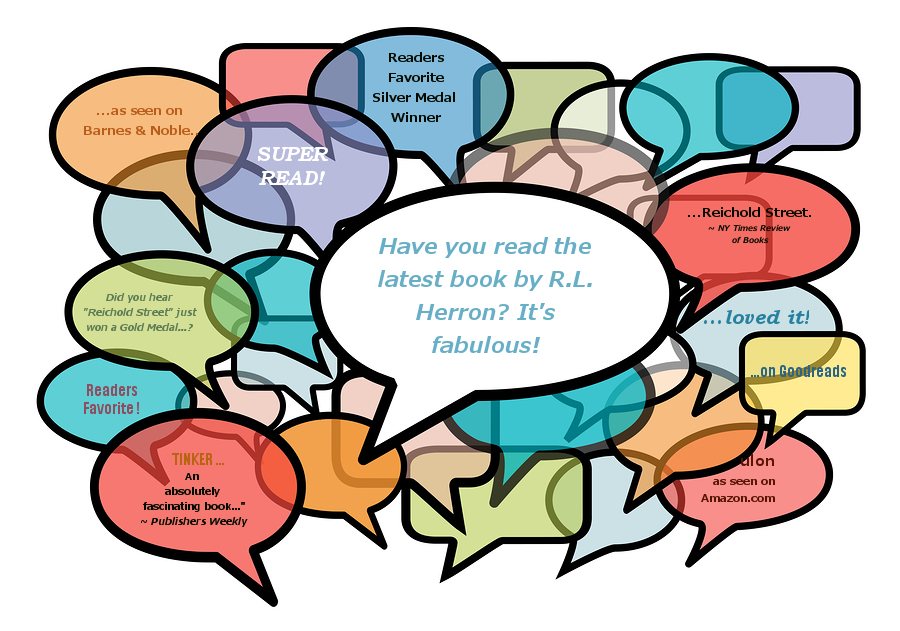
Earned media is really just the digital-age term for word-of-mouth advertising. It’s an idea that has grown hand-in-hand with content and social media marketing and the notion that a viral success can cheaply translate to mega-exposure.

Everyone wants earned media.

Marketing agencies know this, and they routinely pitch their ability to generate it. Most businesses, even small ones, are embracing the earned media paradigm to shape their social media strategies. Indie writers are no exception.

However, there are many misconceptions floating around the notion of earned media via the use of social media.

Earned Media Has a Number of Advantages
Many of them are obvious. (1) it’s “free,” in the sense that there’s no direct payment for the exposure provided; (2) it’s transparent, in that brands need not rely on intermediaries to measure it; and (3) it tends to create greater trust than paid or owned messages.

People trust the enthusiasm and recommendations of friends, acquaintances and professional networks more so than ads.

The Disadvantages Are Less Obvious
The real disadvantage has to do with earned media’s hidden cost. It requires investment in internal and external social media content generation. It takes time and effort.

Sometimes a lot of effort.

This week, I spent some time looking over past entries to my blog, because I thought they might make an interesting booklet if compiled and published together. One I could sell.

Looking at them, however, I noticed I keep talking about writing blogs and the Twitter and the Book of Face, as though they’re going to help, all by themselves in some magical way, reach out to fans, create a nice fan base and sell books.

I keep pushing new media as the be-all and end-all of promotion, completely forgetting the many years I spent dealing in old media to sell things.

Old media that worked.

It made me realize I’m not doing justice to readers who are looking for indie writing/publishing advice by pushing so hard on the new media tack without completing the story. Being an indie writer myself and talking about my experiences is not sufficient.

I do mention the need for word-of-mouth publicity, and I’ve written about earned publicity … not paid publicity. I just don’t do it enough.

Evaluate Social Media
When you consider maybe half the people in a social network will actually see a posting (assuming they aren’t following so much stuff they don’t have time to read any of it), and maybe one percent of those who see it will respond, and about five percent of the responders will buy, you’ll understand why marketing types today use this formula to evaluate social media:

(followers) x (50% see it) x (1% pay attention) x (5 % buy it) = sales.

Using this as gospel, you can figure out what the outcome will be for any given social networking post. For the sake of example, I’ve chosen an audience following of 100,000 (I should be so lucky). It works out something like this:

100,000 x 50% x 1% x 5% = 25

You read that right. Assuming you have something to sell, a posting to 100,000 followers on your social media site (your blog, the Twitter, the Book of Face, or whatever else you use) could possibly translate into 25 sales. Maybe.

Twenty-five. That’s it.

Considering all the time I spend on those sites, those numbers made me feel sick, too.

I have almost 2000 follows here. Another 1650 on The Twitter. Only about 53 on the Book of Face (I’m not real active there). I’m not at all sure about Pinterest or Tumblr or LinkedIn or any of the others I’m on and vaguely familiar with, so I won’t count them.

So let’s say it’s about 4000.

Let’s see … 4000 followers x 50% x 1% x 5% = 1.

Seems I’m way ahead of the curve with my actual sales, but it still isn’t promising. Mediocre is more like it. Never mind my first two books are award-winners. They don’t sell as well as I would hope.

So What Are We Supposed To Do?
There are scads of untalented hacks … people who couldn’t write their way out of a wet paper sack with two sharpened pencils and an axe … who sell more books than some great writers.

And I’m not talking about books in some alternative universe. These untalented non-writers sell all kinds of books right here on good ol’ planet Earth: non-fiction and fiction.

What’s the secret? You know their name.

That’s it. Name recognition.

Nothing is more powerful. If you want to reach a mass audience, you must use mass media. Must. Not should.

Must.

You see, it doesn’t matter how good your book is … and why simply telling people how good it is on social media won’t, all by itself, help. It’s why someone like Glenn Beck (or whomever it is who writes his books for him), have books on the best seller list.

People know his name (the same is true of non-talented folks like the Kardashians, too … so I’m not just picking on you, Glenn).

Use the same formula I just gave you, but assume 200 million people around the world know your name. Go ahead, do the math.

(200,000,000 people) x (50% see it) x (1% pay attention) x (5% buy it) = 50,000 sales.

That’s a bestseller right there.

Quality doesn’t necessarily matter when exposure is that high.

But to reach the kind of volume you need to achieve those numbers, your plan has to include ideas for reaching out to every form of mass media: newspapers, magazines, blogs, radio and television.

And since you don’t have an automotive company’s marketing budget, you need earned media.

Earned Media
Earned media refers to favorable publicity gained through promotional efforts other than advertising. In other words, free publicity.

Wait, you say. With social media, you can reach a mass media-type audience. Yes, but will you reach as big an audience? No.

But, you continue, everything you write will at least get out there, and the mass media may decide to cover something after spotting it in the wild, if enough people pick it up and repeat it.

That, Gentle Reader, is true.

Self-Serving Posts Don’t Get Read
But a common mistake is to treat social media as a monologue, and to make it self-centered. That’s why you see a lot of Book of Face pages that are often ‘me’ focused (including mine sometimes, sadly) and feeds on The Twitter that are just links to press releases.

In order for social media to be earned media means it isn’t something you wrote about you. You may start the conversation, but it’s a dialogue to which a lot of people contribute.

The best use of social media to try to achieve this … is to give your audience something. Inform them. Entertain them. Give them news they can use. Ask questions. Figure out why an average person would read what you’re saying. What would they get out of it? Indie authors trying to promote themselves should be no exception.

Give Your Audience the Best Value You Can
Then make it easy. By that, I mean make it simple … and make it easily found. Link things so whatever you post on your blog automatically gets on your Twitter feed, or on Tumblr, or the Book of Face … whatever you use. The more places the better.

Make it easy for other people to write and post content without jumping through a bunch of hoops.

Create a short video, put it on the You of Tubes and learn how easy it is to embed that video on your blog or put it on your Book of Face pages (I already do). Record a podcast and do the same experiment (I’m working on it).

The ideal system lets you write and post with the fewest steps possible, with your posting system linked to your other social media. Most new blogging platforms like WordPress will automatically sync with other social media like Book of Face and the Twitter, so every post you put up on your blog gets put on those other places, too.

Social media isn’t a replacement for earned media, but it’s a growing force for getting there and it’s becoming standard these days for any public figure or public figure wannabe.

If you’re in the public relations business … and, believe me, if you’re an indie writer trying to promote your writing you are … and you aren’t using social media, people today will look at you funny, as if you don’t believe in telephones.

You need to get dialogue going. More importantly, you need to have other people talking about you and your books. You absolutely need it.

Like my sons told me months ago, when they urged me to blog, tweet and Book on Face about my books … get into the 21st century, Pop.

What do you think? Share your thoughts in the comments section.

—————-

New York Review of Books – A Reminder
Look for the mention of my novel REICHOLD STREET in the September 26, 2013 Fall Books issue of The New York Review.

—————-

Creating Believable Characters
Don’t forget to click on the link in the right-hand column to get your copy of “Creating Believable Characters.” It was written specifically to aid writers with their character development and the price shouldn’t be a deterrent … it’s FREE.

—————-


What’s the Best Kind of Book Publicity?

July 12, 2013

success_cropped
How Do You Spell Book Publicity Success?

One of my new favorite bloggers, Guy Bergstrom, has some witty insights about generating publicity for film, music or books — and one of his blogs speaks directly about some of the things I’ve talked about here before — the supposed “secrets” of getting your self-published book noticed.

Actually, many of Guy’s blogs do that, so do yourself a favor and head over there, using the link I provided above, and just browse a while. You won’t be disappointed.

Of course, I naturally recommend you visit after you’re done reading and commenting here. (Guy follows this blog, and I hope he’ll forgive me for asking you to wait but, hey, I’ve got things to say, too).

If you’re an indie author, I’m sure you’ve discovered marketing is the hardest part of your literary creation’s World Conquest.

Once you’ve covered all your siblings, cousins, friends and neighbors with “The Word” about your new book, how do you reach the other 7,164,485,136 people on this shiny blue pebble?

In truth, you don’t have to. You’d probably be deliriously happy with only two percent of those. I know I would. That’s still almost 150 million people … and if just one percent of those actually bought a book it wouldn’t cause J.K. Rowling to lose any sleep, but you’d be very comfortable.

The Best Publicity
Which brings me back to The Big Question. How do you reach that interested one percent of two percent audience, meaning an audience willing to part with a couple of nickels to buy your book?

“The Twitter” as Guy calls it, doesn’t sell any books. It isn’t meant to.

It’s a site for meeting people and you’re bound to find a lot of other friendly creative writer types who’ll be nice to you … as they Tweet to sell you their own book.

But the best way to use Twitter — or any other “social media” for that matter — is, as I’ve said before, to create and share meaningful dialogue with those friendlies, not to harangue people with a “BUY!” message. That only gets you “unfollowed” in a hurry.

Earned Media
The best route to publicity, short of marrying whatever star / starlet is prominently undressed in the latest apocalypse movie, rescuing the Pope from terrorists, curing cancer, or crossing the Grand Canyon on a tightrope — which wouldn’t work anymore anyway since Nik Wallenda already did it — is with earned media.

Earned media is media you don’t buy, but earn the hard way.

PR is an example of earned media. Word of mouth is another. The good thing about it, other than it works … it’s free.

publishers weekly photo small

I followed some of Guy’s advice and got a mention for my award-winning novel REICHOLD STREET in Publishers Weekly. I’ve also been interviewed for an article in the local paper. I was prepared, because I’d already completed something else I mentioned that you, as an indie writer, need to have … a dedicated media page.

I know, I know, it’s not the NY Times Review of Books … but it’s a start. And — except for a little bit of my time — it’s free.

A FREE Guide
Speaking of free — you might want to visit the link on the right-hand column of this page, and subscribe for your FREE copy of my booklet “Creating Believable Characters.” I created it specifically to aid other indie writers … and at least the price is right.

Now — after you leave a comment — it’s OK to visit Guy’s page. Just let him know I sent you.