
Posts Tagged ‘award-winning author’

Why Walk Away From Your Writing?

March 31, 2014

shoes
Finding My Muse in Montego Bay.

Sometimes the only way you can make progress as a writer is to walk away from it.

Like many authors, I’ve joked about tying myself to my office chair in order to finish a story. After all, like my dear father tried to drum into my head while I was growing up, perseverance is essential to the completion of any project. Isn’t it?

Well … yes.

However, sometimes the determination to never leave your chair can hinder your progress.

The reason for that conundrum lies in how ideas come about.

When you’re stuck in the middle of a manuscript, looking for inspiration, remember the two essential elements for receiving a “light bulb” moment.

1. You Need to Have Done the Work
Your mind needs to have been immersed in the subject, so all the relevant details are already spinning around in your head, and;

2. You Need to Have Walked Away
Relaxing your mind and moving your focus elsewhere allows these swirling possibilities to gradually crystallize into an idea.

Think back to some of your best ideas. Did they happen:

    * While you were in the shower?
    * During a walk?
    * Dozing in church?
    * On your way to work?
    * Just before bed?

What Do These Situations Have in Common?
For one thing, you’re not in front of your computer staring at a blank page. They’re moments when your mind was distracted by other things.

Meanwhile, in your subconscious, elements you may never have consciously associated with one another coalesce to form the solution to your problem.

Naturally, you can’t spend all your time wandering about the house or standing in the shower, hoping every element of your story will magically appear in your head.

So when should you walk away from your writing and when should you stay? Try this handy checklist:

Freewriting
Our fear of the blank page often stops us from writing, even if the words are ready to come. Freewriting, or stream-of-consciousness writing, forces you to get words out just to get your flow started. The key is not to get caught up in perfectionism. Try literally forcing the words out, even if they’re rubbish.

Stay On Track
Sometimes a writing block is caused by an earlier wrong turn we’ve taken … perhaps a spot where we forced a character to do or say something that just didn’t fit. Read back over your manuscript to see if there was a point where your prose became labored. If you find it, try starting fresh from that point.

Character Profiling
If the words aren’t coming easily, perhaps it’s because the world of your story, or the characters who inhabit that world, are not yet well defined. Instead of trying to add to your word count, spend your writing session trying to better describe your world or interviewing a character.

Limit the Time You Stare at a Blank Page
Past a certain point, perhaps 30 minutes, simply gluing your butt to the chair just doesn’t cut it anymore. If you’ve been doing all of the above and you’re still no further along, trust me, you’re ready to walk away.

How Long Should You Leave?
Sometimes a few minutes will provide enough release to bring the rush of ideas. You might be surprised how quickly the words return.

If that doesn’t work, you may need to leave your writing for more than that … even for a day or two. I did just that, thanks to a generous invitation from my son and his family to join them in Jamaica for a week.

You may remember I’ve talked about my REICHOLD STREET sequel being stalled now for more than a month. My “thousand words a day” mantra had become hopelessly bogged down. Ideas just wouldn’t come. I tried stimulating my brain with every hackneyed piece of writing advice I’d ever heard.

Nothing worked.

So, when that generous invitation came from my son, I walked away from my writing. I even did the unthinkable: I left my laptop at home in Michigan (the craving only lasted about a day).

Great Advice
One of the surprises, at least for me, of finishing my first novel was discovering just how many of the most hackneyed pieces of writing advice actually turn out to be true.

For example: nearly every author interview will include some reference to how important it is to just sit down in the chair … meaning, the best way to get writing done is simply to sit down and get it done (Hemingway famously said “There’s nothing to writing … you simply sit down at the typewriter and bleed.”)

And then there’s the best piece of writing advice I’ve actually ever received (even better than Anton Chekov’s “Show, don’t tell”). You’ve probably heard it before:

Write the book you want to read.

I know what you’re thinking … of course, that makes sense, but why bring it up? Because it’s easy to confuse this advice with a very similar, and very bad, piece of advice: Write the book you want to write.

Here’s the Important Distinction:
The book you want to write is the book that, in your fantasies, you’re autographing at your overcrowded book signings and seeing projected across the back of the stage when you win every literary prize available. That’s the book you want to write.

The book you want to read, by contrast, is the book you’d curl up with if you knew you’d be spending time in, say, some tropical island somewhere … like Jamaica. It’s the book you can lose yourself in … then stash on the shelf, dog-eared and half-destroyed, only to pull out every year to read all over again. That’s the book you want to read.

And the latter is really the book you should be striving to write. Write to entertain. Forget the awards. If your book is worthy, they’ll come. But I’d much rather have a host of happy readers.

I walked away from my writing … completely … for more than a week. Now that I’m home again, I’m delighted to also be writing again. Another 6,000 words. Good ones … all of them keepers … in the last five days.

I found the muse again by walking away, and when I’m done with One Way Street, I know it will be a book I, and hopefully others, will want to read.

How Do You Defeat the Self-Doubt Monster?

March 3, 2014

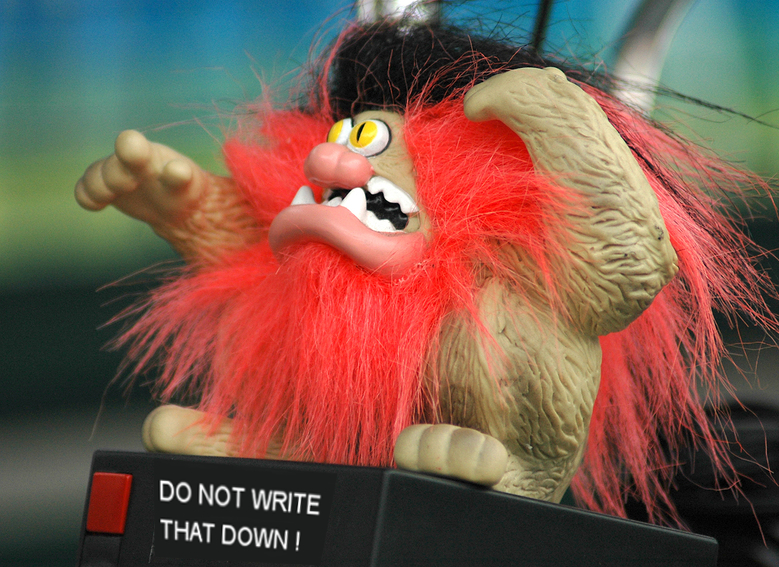
generic troll dollFor Writers, Self Doubt is Always Around

There’s a monster hiding under my kitchen table. He lurks there, waiting for the right moment to attack, because that’s where I park my laptop most days to write. If you’ll pardon me saying so, he’s an ugly little bastard, too.

I have quite a few names for him, most of them considered unmentionable in mixed company, but in this blog, I’ll call him by his real name … Self-Doubt.

You might think, after more than four decades of work in high-profile, demanding jobs … and winning book awards I once only dreamed about winning … that I’d have managed to kill the blasted thing by now.

But you’d be wrong.

The sneaky little devil keeps popping up. It’s why my REICHOLD STREET sequel is stuck at 49,000 words.

Self-doubt is something most writers face from the first day they start writing, and the inability to fight it prevents most would-be writers from becoming published authors.

You see, the ugly little troll doesn’t care what you accomplish. All he wants is another tasty bite out of your confidence.

He’ll tell you whatever you’ve written so far in that new manuscript is crap. He’ll whisper in your ear that you’re wasting your time … that cleaning the grout in your bathroom tile (like your wife asked you to do weeks ago) is much more important.

Sometimes he even possesses your family and friends. You’ll know when he does, because they’ll say things like, “How long are you going to put yourself though all this before you find something else to do with your time?”

He can make you believe the one negative review you received out of a batch of twenty really good ones is the only one you should listen to. And if you let him, he’ll not only slow you down, he’ll rob you of the passion you feel for writing.

So how do we slay the ugly little so-and-so, or at least keep him at bay? Below are five tips to keep self-doubt from chewing on your sanity.

Stay Out of Ruts
If you’re not feeling any passion for your writing, try spicing things up by doing something different. Try writing in a new genre, or from a different point of view. Nothing can get you out of a rut quicker than feeling challenged.

Be Aware of Peer Pressure
I preached this to my kids while they were growing up, but it’s easy to forget that the bad habits of the people we hang out with are as contagious as a stomach virus. If you’re around people who’ve lost their ability to chase their dreams, you’re at risk of becoming just like them. Be strong.

Continue Learning
You can keep the gremlin from nagging that you don’t know what you’re doing by growing continually as a writer. Read the books of other writers, a lot of them; take classes; attend conferences; and go to those local writer-group meetings to listen to what other writers offer as advice. Then read some more.

Mentor Someone
Nothing can inspire you more than helping and encouraging another person (it’s one of the reasons I started this blog). Telling others they have to believe in themselves is a sure way to rekindle your own self-confidence.

Accept You’re Going to Fail Sometimes
I hate to tell you this … you’re going to make mistakes. We all do. And if you’re intent on following the “traditional” publishing route, you’re going to get rejections. Probably lots of them.

The sad truth is it might even take years just to accomplish securing an agent to represent you.

Those two well-known facts are part of the reason I turned to indie publishing in the first place.

I completely understood that I wasn’t going to be the first person to get a rejection, or the first to have trouble securing an agent. I knew the number of rejections you receive doesn’t matter … that you’re not defeated until you let yourself be.

Just Do It!
But I was already retired from a regular career … and a long way from a spring chicken. The main thought that kept running through my mind was:

How much time to do this do I really have?

I wanted my work published and available and didn’t want to wait. So, I took that leap of faith. I self-published … and got lucky. Two of my first three books, REICHOLD STREET and ZEBULON, were award-winners.

Is the self-doubt monster gone for me now? No. I don’t suppose it ever will be, and there’s only one thing I can really say about the whole business with any certainty.

Writing isn’t for wimps.


How Do You Write Good Dialogue?

February 24, 2014

boy listening to tin can telephoneThe Secret to Dialogue is Good Listening

Interesting, believable dialogue has been mentioned several times in reviews of my stories. I’m delighted and actually quite proud of that. However, when someone asks me how to do it, there’s only one thing I can say …

Listen
That’s not a joke. If you seriously want to learn the secret to good dialogue, listen to the way people talk … really listen. I do it so much it’s second nature. If you haven’t conciously done it before, take the time to listen to the conversations you hear around you.

Listen to people talking to each other in the check-out line at the grocery store. Eavesdrop on the conversations at other tables in restaurants. Listen to friends talking at social gatherings. Jot down words and phrases.

When you do, the first thing you’ll discover is that no one speaks the way your grade school teacher told you they’re supposed to when she was teaching you grammar (sorry, Mrs. Bliss).

When you listen, it shouldn’t take long to notice the poor grammar, misplaced modifiers, mispronounciatons, sarcasm (both intended and unintended) and allusions that people include in their routine conversations with one another.

You’ll discover believable dialogue is no big secret … it’s just not necessarily proper English.

People get the “poor grammar” and sarcasm part. We all speak in a way that’s less than perfect. It’s when I talk about allusions that most people ask questions. They want to know more about what an allusion is, and how to use it.

It really isn’t hard to describe.

Allusions in Dialogue
An allusion is a reference within your work to another work: a book, a film, a piece of artwork, a known quotation or even a real event. They’re often used to summarize complex ideas in one quick, powerful image, getting your point across without lengthy paragraphs of description.

Think of it as a kind of shorthand that provides greater meaning to what you’re writing about, by relating it to an already familiar story. I often think of allusion as a kind of modern day hypertext, linking the reader to another thought.

There are poems, like T.S. Eliot’s “The Wasteland,” which rely heavily on allusions and practically sample the works of others, the way local bands go through other artists’ songs at a wedding. It’s quite a challenging read (and definitely not one of my favorites).

However, good allusions are contingent on the reader knowing about the story or event being referenced. While they can be an economical way of communicating, you risk alienating anyone who doesn’t recognize the reference … or, as T.S. Eliot did with me … making it so hard to decipher you finally say the hell with it.

As a writer, the absolute last thing you want is for the reader to leave the story.

Allusions in Titles
However, allusions don’t have to be difficult. They can also be quite subtle. For instance, Shakespeare’s influence on English literature is so strong that we often make allusions to his plays without being aware of it.

For instance, these five books give a nod to the bard simply by using his words in their titles.

    “Brave New World” by Aldous Huxley;
    “Something Wicked This Way Comes” by Ray Bradbury;
    “The Sound and the Fury” by William Faulkner;
    “The Gods Themselves” by Isaac Asimov, and
    “The Winter of Our Discontent” by John Steinbeck

Common Dialogue Examples
Good allusions are also found in dialogue. How many times in simple dialogue have you heard something referred to as a “Pandora’s Box?” It’s an allusion to Greek mythology.

The box was actually a large jar given to Pandora which contained all the evils of the world. She was admonished not to open it, but curiosity got the best of her, and all the evil was released when she lifted the lid.

Today the phrase “to open Pandora’s box” is an allusion that means to perform an action that may seem small or innocent, but turns out to have severe and far-reaching consequences.

“I was surprised his nose wasn’t growing like Pinocchio’s.” This is obviously an allusion to “The Adventures of Pinocchio,” written by Carlo Collodi, where the character’s nose grew whenever he told a lie. Even schoolchildren know the story.

“She acted like a Scrooge and refused to buy anything that wasn’t absolutely necessary, and even some things that were.” Scrooge, as most of you know, was an extremely stingy character from Charles Dickens’ “A Christmas Carol.”

Both allusions help cement the writer’s character in our minds without lengthy exposition. We know quite a bit about the writer’s intent for them from one sentence. Both sentences, you will note, are also comments any character might make in simple dialogue.

Thus, allusion doesn’t have to be something that makes reading difficult. It can be found in some of the simplest sentences.

Allusions Are Everywhere
However, the use of allusions is not confined to literature alone. We often refer to common people and places in our speech that are quite apart from scholarly things.

If you pay attention to the conversations going on around you, the occurrence of allusion is fairly common in our daily speech. “Stop acting like my ex-husband please.” That was an actual remark I overheard at a recent social event.

While the reason behind the statement is unknown, the implication of rudeness and distaste in that single sentence tells us a lot about what one character is really saying to another.

Allusion. A useful tool in a writer’s toolbox.