Archive for the ‘Storytelling’ Category

How Do You Excite Readers?

June 24, 2014

Child With Magic Book

An excellent question.

Regardless of the genre in which you write, the best way to make your stories come alive is to write exciting, clear, descriptive prose and believable dialogue.

If that sounds like work, I suppose you could always try what I described in my last post. Grab a bare live electric wire … and hope you live to tell someone about it. It was definitely exciting.

However, it’s not something I would recommend.

I was fortunate to have only brushed the bare wires, not grab them … which could have created a whole different and, in my view, quite unwelcome outcome.

My brush with electrical stupidity didn’t mean the big nasty that electrocution could be … it just threw me to the ground and caused me to make a complete tear of the rotator cuff ligaments in my left shoulder.

The orthopedic surgeon figures with a couple hours of surgery, six weeks of immobility and months of rehabilitation, I’ll be something (hopefully) approaching normal again.

Given my history of normal, that could scare some people.

I’ve been through a similar scenario once before and remember the weeks of discomfort it meant. I’m not looking forward to it. The good news is I recovered … and I can now tell when the weather is going to change by the ache in my arm.

I also once broke the elbow in the same arm, trying … and failing … to prove I could still play football with seventeen-year-olds. I can’t, but at my age that’s not a bad thing. Is it?

I figure with this latest injury I’ll at least now have the weather-change info in stereo.

Unfortunately, it also means my writing and typing process is considerably slowed. I’ll be forced to type with only my right hand. I know for many this isn’t a problem. I’ve seen some of you type, and you’re only using a couple of fingers anyway.

But for me it’s a real problem. I wanted to get the third book of my Reichold Street trilogy published before the end of the year. Certainly by the first quarter of 2015.

And I do know how to type, so this slows me down considerably. I’ve already thought about recording my thoughts and transcribing them later but, while this is a good way to review my work, I find it cumbersome to begin that way.

Perhaps I should use this time to do some of the things I’ve been meaning to do … like go to book-signings, visit reading groups, talk to classrooms and generally get out and hobnob with some of the folks I’d like to reach with my books?

Perhaps I could do a reading for some of them and talk about how I come up with ideas?

Without both arms to gesture with as I talk, I’ll effectively be whispering … but, perhaps, they’ll pay more attention that way.

What do you think?

==========

You can find my books as eBooks or paperback on Amazon, or at Barnes & Noble. You’re also invited to visit my web site, BROKEN GLASS, or like my Book of Face page. You can also follow my shorter ramblings on The Twitter.

==========

Where Do You Find Inspiration?

June 5, 2014

Creative Concept Image
Finding Inspiration Is Hard Work

Now that my “Reichold Street” novel sequel “One Way Street” is finished, I’ve started to brainstorm about the ideas I originally had for a trilogy.

It’s one of many times I’ve wished I could peek inside the mind of one of the world’s greatest writers and find out exactly what makes him tick. Wouldn’t you, if you could?

Well … actually you can.

On Writing
Whether you’re a fan or not, Stephen King has published 50 novels, all of them bestsellers. He’s sold more than 350 million copies of his works. According to Forbes, he earns approximately $40 million per year, making him one of the richest writers in the world.

In 2002, he temporarily abandoned writing horror novels to publish On Writing, a book discussing exactly how to become a fabulously good writer. Since then, it’s become the most popular book about writing ever written.

Here’s why: The book is magic.

As you read through it you can’t help being exposed to the fundamentals of the craft. You also discover writing isn’t meant to be a chore. It’s more like an adventure through undiscovered worlds, where no one knows what’ll happen next.

Where other writing books are focused on the mechanics of the written word, King shows you how to capture the joy of the craft.

You’ll find yourself wanting to write … because it’s fun.

Personally, it inspired me more than any other book about writing I’ve ever read. If I could recommend only one book to writers, On Writing would be it.

Here are some of the quotes you’ll find:

“I’ve written because it fulfilled me. Maybe it paid off the mortgage on the house and got the kids through college, but those things were on the side … I did it for the pure joy of the thing. And if you can do it for joy, you can do it forever.”

I’m sure we’d all agree money, adulation and prestige would be nice. But since I don’t expect that’s going to happen, it’s not what drives me to the keyboard. It’s really about the rush of watching an idea take shape on the page.

Everything else, should it happen, is just a happy bonus.

“If you want to be a writer, you must do two things above all others: read a lot and write a lot.”

I’ve mentioned this before, but that’s really how it works. Every popular writer reads an enormous amount … and writes every day. I’ve been known to read three novels a week and I try to write a minimum of 1,000 words each day. It may seem like a lot but success, if it comes, comes at a price.

As a writer, are you willing to pay it?

“All the arts depend upon telepathy to some degree, but I believe that writing is the purest distillation.”

In school, we’re taught writing has three and only three purposes: to inform, to entertain and to persuade. However, that maxim is missing a subtle requirement.

To inform, first you have to be informed. To entertain, first you have to be entertained. To persuade, first you have to be persuaded. So read. Then and only then are you ready to write.

And when you do, your job isn’t so much jotting down words on the page as it is beaming the ideas inside your head into the heads of other people.

Words are just the medium through which the transfer happens.

“Write with the door closed, and rewrite with the door open.”

The truth is, any great piece of writing is preceded by hours and hours of thinking. You must have more respect for the power of words than to spit them out without any real forethought.

To understand better what that means, try this:

Write as if no one in the world will ever read it.

Say exactly what you feel. Don’t think. Just get your thoughts out there in all their disheveled, chaotic glory. This is what Stephen King calls writing with “the door closed.”

It’s just you and your work … the very first stage of writing.

The second stage is opening the door to the rest of the world — a metaphor for pondering how the average Joe might respond to your new creation, and making the changes necessary to help it survive. And yes, don’t fool yourself, there will be changes.

Lots and lots of them.

To many aspiring writers, a great piece of writing is something mystical, filled with an almost frightening power. They look at the writers who create such magic with reverence, longing for the day they can discover the closely-guarded “secrets.”

It’s silly. Yes, there is some magic to it, but the same magic exists in every type of art and it’s accessible to everyone. Here’s how: Write. Every day. For years. And know your audience.

Is it hard work?

Yes, but so is any job worth doing.

“We’ve all heard someone say, ‘Man, it was so great … I just can’t describe it!’ If you want to be a successful writer, you MUST be able to describe it, and in a way that will cause your reader to prickle with recognition.”

If you pay attention to only one quote in this article, pay attention to that one.

A writer’s job isn’t so much saying what he thinks as it is putting his readers thoughts into words. He needs to describe actions with such clarity and intimacy they suspect him of reading their minds.

Understand what they want. Don’t tell them the action; show them. Do that, and you won’t have to beg your readers for their attention. They’ll follow you to the ends of the earth.

The mistake most wannabe writers make is never trying anything new at all. They do whatever their English teachers told them is “right.” And that’s just sad (sorry again, Mrs, Bliss).

The reason most writers fail isn’t a lack of technical know-how. It’s a refusal to take what they do seriously. They never put in the work to make it anything worthwhile. They never understand what their readers want.

So, as I head home from visiting my oldest sons and my grandkids to begin the final book in the Reichold Street trilogy, I’m trying to do the work to understand what the readers want to see.

I’ve been writing with “the door closed” and I’ve got my thoughts together already for Chapter One, in all their disheveled, chaotic glory. Let me know what you’d like to see next. I promise I’ll listen. Believe me, your comments are most welcome.

After myself, you’re the ones I’m writing for.

==========

You can find my books on Amazon. You’re also invited to visit my web site, BROKEN GLASS, or like my Book of Face page. You can also follow my shorter ramblings on The Twitter.

==========

Why Walk Away From Your Writing?

March 31, 2014

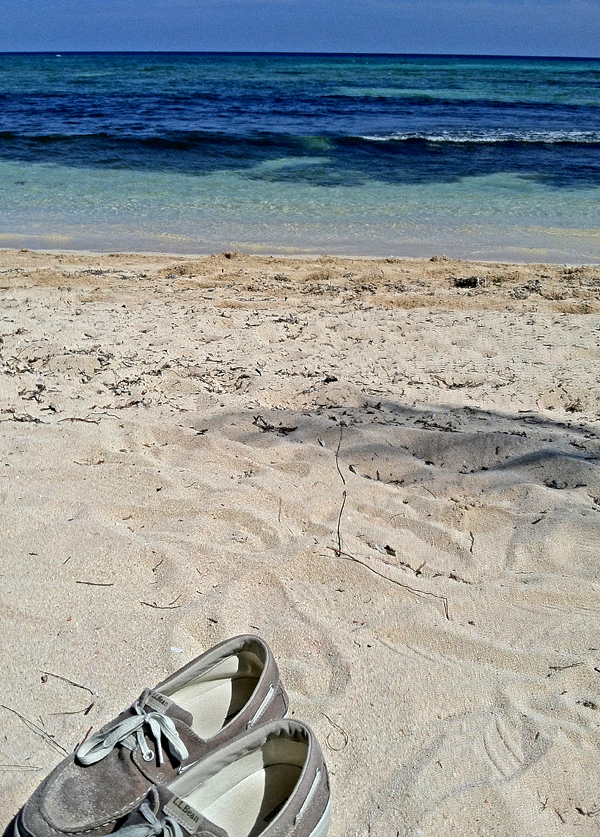
shoes
Finding My Muse in Montego Bay.

Sometimes the only way you can make progress as a writer is to walk away from it.

Like many authors, I’ve joked about tying myself to my office chair in order to finish a story. After all, like my dear father tried to drum into my head while I was growing up, perseverance is essential to the completion of any project. Isn’t it?

Well … yes.

However, sometimes the determination to never leave your chair can hinder your progress.

The reason for that conundrum lies in how ideas come about.

When you’re stuck in the middle of a manuscript, looking for inspiration, remember the two essential elements for receiving a “light bulb” moment.

1. You Need to Have Done the Work
Your mind needs to have been immersed in the subject, so all the relevant details are already spinning around in your head, and;

2. You Need to Have Walked Away
Relaxing your mind and moving your focus elsewhere allows these swirling possibilities to gradually crystallize into an idea.

Think back to some of your best ideas. Did they happen:

    * While you were in the shower?
    * During a walk?
    * Dozing in church?
    * On your way to work?
    * Just before bed?

What Do These Situations Have in Common?
For one thing, you’re not in front of your computer staring at a blank page. They’re moments when your mind was distracted by other things.

Meanwhile, in your subconscious, elements you may never have consciously associated with one another coalesce to form the solution to your problem.

Naturally, you can’t spend all your time wandering about the house or standing in the shower, hoping every element of your story will magically appear in your head.

So when should you walk away from your writing and when should you stay? Try this handy checklist:

Freewriting
Our fear of the blank page often stops us from writing, even if the words are ready to come. Freewriting, or stream-of-consciousness writing, forces you to get words out just to get your flow started. The key is not to get caught up in perfectionism. Try literally forcing the words out, even if they’re rubbish.

Stay On Track
Sometimes a writing block is caused by an earlier wrong turn we’ve taken … perhaps a spot where we forced a character to do or say something that just didn’t fit. Read back over your manuscript to see if there was a point where your prose became labored. If you find it, try starting fresh from that point.

Character Profiling
If the words aren’t coming easily, perhaps it’s because the world of your story, or the characters who inhabit that world, are not yet well defined. Instead of trying to add to your word count, spend your writing session trying to better describe your world or interviewing a character.

Limit the Time You Stare at a Blank Page
Past a certain point, perhaps 30 minutes, simply gluing your butt to the chair just doesn’t cut it anymore. If you’ve been doing all of the above and you’re still no further along, trust me, you’re ready to walk away.

How Long Should You Leave?
Sometimes a few minutes will provide enough release to bring the rush of ideas. You might be surprised how quickly the words return.

If that doesn’t work, you may need to leave your writing for more than that … even for a day or two. I did just that, thanks to a generous invitation from my son and his family to join them in Jamaica for a week.

You may remember I’ve talked about my REICHOLD STREET sequel being stalled now for more than a month. My “thousand words a day” mantra had become hopelessly bogged down. Ideas just wouldn’t come. I tried stimulating my brain with every hackneyed piece of writing advice I’d ever heard.

Nothing worked.

So, when that generous invitation came from my son, I walked away from my writing. I even did the unthinkable: I left my laptop at home in Michigan (the craving only lasted about a day).

Great Advice
One of the surprises, at least for me, of finishing my first novel was discovering just how many of the most hackneyed pieces of writing advice actually turn out to be true.

For example: nearly every author interview will include some reference to how important it is to just sit down in the chair … meaning, the best way to get writing done is simply to sit down and get it done (Hemingway famously said “There’s nothing to writing … you simply sit down at the typewriter and bleed.”)

And then there’s the best piece of writing advice I’ve actually ever received (even better than Anton Chekov’s “Show, don’t tell”). You’ve probably heard it before:

Write the book you want to read.

I know what you’re thinking … of course, that makes sense, but why bring it up? Because it’s easy to confuse this advice with a very similar, and very bad, piece of advice: Write the book you want to write.

Here’s the Important Distinction:
The book you want to write is the book that, in your fantasies, you’re autographing at your overcrowded book signings and seeing projected across the back of the stage when you win every literary prize available. That’s the book you want to write.

The book you want to read, by contrast, is the book you’d curl up with if you knew you’d be spending time in, say, some tropical island somewhere … like Jamaica. It’s the book you can lose yourself in … then stash on the shelf, dog-eared and half-destroyed, only to pull out every year to read all over again. That’s the book you want to read.

And the latter is really the book you should be striving to write. Write to entertain. Forget the awards. If your book is worthy, they’ll come. But I’d much rather have a host of happy readers.

I walked away from my writing … completely … for more than a week. Now that I’m home again, I’m delighted to also be writing again. Another 6,000 words. Good ones … all of them keepers … in the last five days.

I found the muse again by walking away, and when I’m done with One Way Street, I know it will be a book I, and hopefully others, will want to read.