Archive for the ‘Storytelling’ Category

Using Myth and Superstition

August 25, 2017

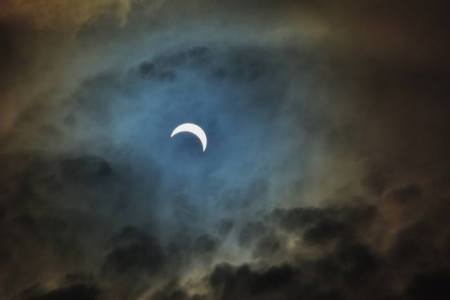
Photo Courtesy Michael Dwyer.

Like a significant percentage of Americans, I was absorbed in the recent (August 21, 2017) spectacle of the solar eclipse.

While we now know the astronomical reasons for the event, ancient cultures, without such scientific understanding, tried to explain why the Sun temporarily vanished from the sky … with legends.

It wasn’t difficult to imagine how solar eclipses were once a cause of fear that became associated with myths, legends and superstitions throughout history. Even today, an eclipse of the Sun is considered a bad omen in many cultures.

Myths and Superstitions
My curiosity aroused, I looked up several of those legends. In Vietnam, people believed a solar eclipse was caused by a giant frog devouring the Sun, while Norse cultures blamed wolves. In ancient China, a celestial dragon was thought to lunch on the Sun.

In ancient Hindu mythology, the deity Rahu, for drinking Amrita, the gods’ nectar, was beheaded by the other gods. His head flew off into the sky and swallowed the Sun.

Ancient Korean folklore offers another explanation. It suggests solar eclipses happen because mythical fire dogs are trying to steal the Sun.

I even found an indigenous American people The Pomo, who lived in the northwestern United States, who told the story of a bear who took a bite out of the Sun. The Pomo name for a solar eclipse translates literally to Sun-Got-Bit-By-Bear.

Predicting the Future
Surviving records have shown that both the Babylonians and the ancient Chinese were actually able to fairly accurately predict solar eclipses, as early as 2500 BCE.

In China, such astronomical events were thought to be associated with the health and success of the emperor, and failing to predict one meant putting him in danger. There is even a Chinese legend that says two astrologers, Hsi and Ho, were executed for failing to predict a solar eclipse.

Historians and astronomers believe the eclipse they failed to forecast occurred on October 22, 2134 BCE, which would make it the oldest solar eclipse ever recorded in human history.

Clay tablets found at ancient archaeological sites show the Babylonians also predicted and recorded eclipses … the earliest known Babylonian record is of the eclipse that took place on May 3, 1375 BCE.

According to the Greek historian Herodotus, a solar eclipse in 585 BCE actually stopped the war between the Lydians and the Medes, who saw the darkening skies as a sign to make peace with each other.

Scientific Discoveries
The word eclipse comes from ekleipsis, the ancient Greek word for being abandoned … perhaps appropriate for what they believed was happening when the sun started to disappear.

Although early eclipse pioneers tried to describe and explain solar eclipses and their features, it wasn’t until 1605 that astronomer Johannes Kepler gave a scientific description of a total solar eclipse.

More than a century later, Edmund Halley (after whom the famous Halley’s Comet is named) predicted the timing and path of the total solar eclipse of May 3, 1715. His calculations were only four minutes off from the eclipse’s actual timing and path.

A solar eclipse is also responsible for the discovery of helium.

The evidence for the existence of the second most abundant element known was discovered by the French astronomer Jules Janssen, during a total solar eclipse on August 16, 1868. Because of this, it’s named after the Greek word for the Sun: Helios.

Proving Relativity
The British astronomer and mathematician, Sir Arthur Eddington, used the total solar eclipse of May 29, 1919 to test Albert Einstein’s theory of general relativity. By taking pictures of stars near the Sun during totality, Eddington was able to show gravity can indeed bend light, almost exactly as Einstein predicted.

It might be hard to picture widespread panic ensuing during an eclipse in modern-day North America, but there is no doubt the events struck immense fear in ancient people who didn’t understand them … and sought to explain them the best way they could.

I found the myths and legends that have grown up around solar eclipses to be fascinating (these are by no means all of them) and think there must be myriad new story ideas that can be generated about them. I know it works. I’ve used myth and legend before in my own stories. My well-received novel BLOOD LAKE is an example.

You have time to work on it. There won’t be another total solar eclipse until April 8, 2024.

**********

My books have all garnered some terrific reviews, and you can see the ones I have available by using the Amazon link below. Look for them. Better yet, buy one and read it. You just might like it.

buy now amazon

You’re invited to visit my website, BROKEN GLASS, or
like my Book of Face page. You can find me on Goodreads, or follow some of my shorter ramblings on The Twitter.

**********

Visit my web site to hear the remarkable radio interview about my novel “Blood Lake” by The Authors Show.

**********

I plan to attend the Rochester Writers’ Fall Conference at Oakland University on Saturday, October 21, 2017 and hope to attend a book-signing the next day, October 22, 2017, at the Leon and Lulu Books & Authors Event in Clawson, Michigan.

**********

Comments posted below will be read, greatly appreciated and perhaps even answered.

How to Avoid Promotional Black Holes

August 1, 2017

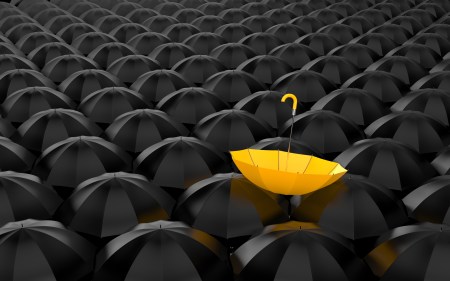
Photo Courtesy Pixabay.

There are so many potential pitfalls that writers must navigate, even seasoned authors can make mistakes marketing a book today.

With hundreds of errors to choose from, here are my choices for seven of the worst ones …

Don’t Have a Web Site
This is a biggie. Authors absolutely need a web site. Traditional publishers expect their clients to have one, and it’s just as necessary … maybe more so … for an independent.

Aesthetics matter, too … and whatever you do, don’t let it get outdated. Updating your site regularly will help with search engine optimization (SEO), which is important to establishing your brand and getting your work out there.

Don’t Play Nice With Others
Another biggie. Other writers are not competitors or enemies. You should be reaching out to collaborate with them. As a community, you’re stronger when you share ideas and support one another (I’ve interviewed other authors on this blog, to help them promote their work … and I’ll do it again, because it all helps).

Don’t Have an Elevator Speech
I’ve said this often, and I’m always surprised when I discover the number of author wannabes who don’t have one ready. You never know when you will be chatting with someone and have an opportunity to mention your book(s). Have a 15-20-second soundbite ready, and share it as often as possible.

Ignore the Power of Reviews
Secure reviews with Kirkus Reviews, Foreword Reviews, Publishers Weekly, Readers’ Favorite, Blue Ink, TopBookReviewers, and others. Some you will have to pay for … but if your work is strong you will find they are like gold. You can never have enough.

Ignore Resources at Your Disposal
Writers fall short when they don’t join useful groups. For instance, I’m a member of the National Writers Association, the Association of Independent Authors, Michigan Writers and the American Academy of Poets. Other fabulous group resources are Independent Book Publishers, the Writers Guild (East and West), and PEN America. Get an author listing on Goodreads, too.

Your Head Isn’t in the Game
Lazy authors are not successful ones. Neither are authors whose ego is so huge they simply fail to hustle. Don’t get blinded by an inflated sense of self-worth. Tone it down, get off your high horse, and be ready to do whatever it takes to get your book out there.

You Don’t Go All In
Don’t say you already have a Facebook presence, when all you did is put up a profile. You need to engage and interact. Think about relevant visuals, personal stories, provocative statements. Be flexible, but don’t scream BUY MY BOOK! Be a friend, not a salesman.

I’ve found the book industry to more social than others in many ways. So, do the socially expected things following a book signing, classroom visit, or speaking engagement. Give the organizers a thank you card … maybe even a shareable goodie of some sort.

It not only makes your host feel good, it gives you a personal energy boost you can tap for weeks. Think of book marketing as doing honor to your work, and the work of others.

Try it. It works.

**********

My books have all garnered some terrific reviews, and you can see the ones I have available by using the Amazon link below. Look for them. Better yet, buy one and read it. You just might like it.

buy now amazon

You’re invited to visit my web site, BROKEN GLASS, or
like my Book of Face page. You can find me on Goodreads, or follow some of my shorter ramblings on The Twitter.

**********

Visit my web site to hear the remarkable radio interview about my novel “Blood Lake” by The Authors Show.

**********

Check out my DEAD END STREET review

**********

I plan to attend the next Rochester Writers’ Fall Conference at Oakland University on Saturday, October 21, 2017.

**********

Comments posted below will be read, greatly appreciated and perhaps even answered.
How Well Do You Use Metaphor?

July 11, 2017


I talked the other day about the use of metaphor adding richness and texture to your language. The strongest metaphors illuminate complex or abstract concepts by translating them into striking images that resonate with readers.

They stand out.

It was Aristotle who said that mastering metaphors is a “sign of genius.” When you create metaphors that are clear, concise, vivid and relatable your readers will do more than understand your meaning … they’ll experience the thrill of discovery.

Consider these examples:

    * “Failure is the condiment that gives success its flavor.”
      ~ Truman Capote

    * “The mind is not a vessel to be filled, but a fire to be kindled.”
      ~ Plutarch

To understand how to use them, if you were to ask yourself what love smells like, what answers might you come up with?

The aroma of chicken roasting in your grandmother’s oven? Freshly cut roses? Your wife’s favorite perfume?

All these things can represent love in a metaphor, because of people’s mental associations with the underlying question. But, of course, love doesn’t actually have an aroma.

Avoid Cliches
Sometimes writers select an image that, while powerful, actually contradicts the underlying message. It’s possible to overwork a metaphor. Stale, overused metaphors don’t resonate with readers. Instead, they become cliches. Select images not merely because they’re powerful, but because they’re apt. Be careful of cliches.

Consider these:
He’s like a bull in a china shop … or
Always go after the low-hanging fruit.

Powerful images … used far too much.

Assess your work using this standard of excellence: Is it clear, concise, tangible, vivid and relatable?

“That horse’s ass would beat the sun awake with a stick, if he could.”

“Townies tended to have multiple tattoos, pierced body parts and hair the various colors of Jell-O.”

The first is a line from my novel Blood Lake (a Readers’ Favorite Bronze Medal Winner), and I don’t think you need the rest of the character description to have a sense of what Luther was like. The second comes from my short story Zebulon (a Readers’ Favorite Silver Medal Winner).

Both of them tell us a lot about the characters. When your metaphors are strong, you’ll forge intimate relationships with your readers. The kind marked by shared discovery and reflection.

What writer among us doesn’t want that?

**********

My books have all garnered some terrific reviews, and you can see the ones I have available by using the Amazon link below. Look for them. Better yet, buy one and read it. You just might like it.

buy now amazon

You’re invited to visit my web site, BROKEN GLASS, or
like my Book of Face page. You can find me on Goodreads, or follow some of my shorter ramblings on The Twitter.

**********

Visit my web site to hear the remarkable radio interview about my novel “Blood Lake” by The Authors Show.

**********

Check out my DEAD END STREET review

**********

I plan to attend the next Rochester Writers’ Fall Conference at Oakland University on Saturday, October 21, 2017.

**********

Comments posted below will be read, greatly appreciated and perhaps even answered.