Archive for the ‘Branding’ Category

Know the Secret of a Great Book Interview?

April 18, 2013

Give an InterviewSecuring a Media Interview Can Be Promotional Gold.

Successful Interviewing for Successful Book Promotion
As a self-published author, the chance to give a personal interview to the media has to be the pinnacle of book marketing opportunities. You can explain your creative process while building interest for your book with potential readers.

Alas, while I wish I was writing this from a more personal perspective, telling you how well my own interview went, I’m not. I have yet to secure a media interview for my own books, although it’s not for a lack of trying, just a lack of trying hard enough.

However, what I can address … from my many years of working in public relations … is the whole issue of media interviews.

While the particulars of each interview may vary widely, here are some tips that can help you deliver effective promotion for your book when that fabulous opportunity does come along:

Practice Makes Perfect
Recruit a family member or friend to ask questions about your book, and practice crafting answers that are direct, meaningful and brief. When you finally do secure an interview opportunity you probably won’t be asked exactly the same questions … but you will have some sense of how you want to answer.

Be Reader-Specific
In an interview don’t just tell the audience about your book; use your way with words to help them see the excitement in it. Show, don’t tell. Build an urgency to purchase in potential readers. The point of the interview is to create a fascination for your work. It’s the meaning of the adage “Facts tell; stories sell.”

Keep It Simple
In fiction, particularly for an indie author, the interview audience is likely to be unfamiliar with your name, your book title, and the genre in which you create. So try to answer questions to properly position your work. The same is true for any social media you decide to use. During your interview, avoid jargon or terminology your audience may not understand.

Watch What You Say
In today’s media, anything you say is fair game. While you want your interview to be printed, quoted, reported, or possibly a “viral” Internet item … that’s only a good thing if it’s something you really want everyone to know. Choose your words carefully. A good rule of thumb is to avoid saying anything you don’t want to see as the headline of the article.

Look For Opportunities
Just because you’ve self-published a book, it isn’t a given that media types will be ringing your phone and flooding your email with requests to talk to you. Bowker estimated they would issue 15,000,000 ISBN numbers in 2012, up from just a bit over a million in 2009. Fifteen million. There’s just too much out there anymore for anyone to come looking specifically for you.

Take your story to them. Build a media page on your website or blog, and make sure people know it’s there (I’m still working on mine, even though it’s been over a month since I wrote my blog post “I Need a What?”)

Contact your local paper, local cable channel, local radio (consider even school radio stations) and flat-out ask them if they’d like to interview a local author. All they can say is no.

But, be prepared, they just might surprise you.
What Makes a Good Bio?

March 25, 2013

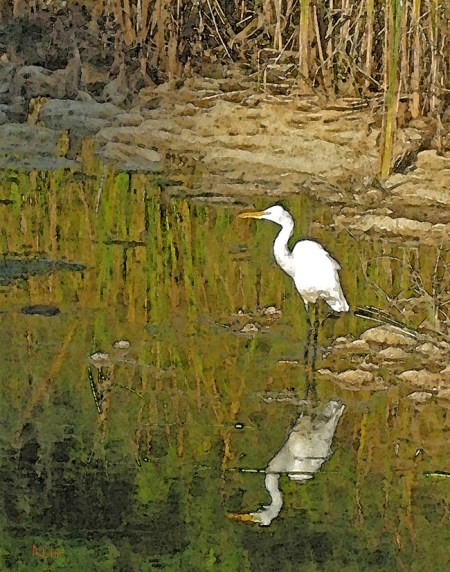
bird watercolorArtwork © R.L. Herron 2011

Ron Herron is a writer who has mastered graphic design, watercolor, photography, speed-reading, publishing, a great variety of computer apps and many other glorious pursuits of diverse ingenuity.

Humility he still needs to work on.

**********

Quite often, when I look at things I’ve written, it occurs to me my bio frequently sounds something like that above. And, in case you’re wondering where I’m going with this, that’s not a good thing.

An awful lot of good people write bad bios for themselves. Every indie author (and a great many other people, too) wants to sound erudite and just this side of awesome … but what they need and what their ego makes them say are generally different things.

I’m guilty of it. Like I said … often.

But by following a few simple rules you can write a good bio for yourself in less time, with less effort and everyone from you, to your mother, to your spouse, to your reader wins.

Impressive People Have Short Bios
Trust me (I have it from the highest authority … my sweet wife), no one is likely to be impressed by a long series of unimpressive things. The shorter your bio, the more people will remember it.

In fact, if you have a great one sentence bio, people may be curious enough to find out more about you. On the other hand, if you have a long, tedious, overly self-aggrandizing one they are almost certain never to want to discover anything more.

They might not even finish reading it.

If you’ve written a New York Times best-seller and are famous enough to appear on TV, your byline will probably only be a few words long: Author. Lecturer. Pulitzer-Prize Winner.

Keep this in mind. I just went through the exercise trying to craft my press release. The goal is to make your bio shorter, not longer.

Invert Your Pyramid
Put the important facts first. Assume with each word fewer and fewer people will be reading. It’s a great assumption because it’s true. It’s something you learn in Public Relations 101.

Don’t try to be clever, unless you’re absolutely sure you are (are you listening, self?). One bad joke can permanently ruin your image.

A sad trend, probably born of Twitter (sorry Twitter), are bios where people self-describe themselves with a multitude of traits (sort of like what I just did above).

Quite frankly, this often backfires and makes you look like either an egomaniac or someone who probably sucks at everything. Just state one or two traits relevant to the audience you’re trying to interest, and let it go at that.

That’s it. You really don’t need any more than that.

Now, if you’ll excuse me one more time, I have to go pass the draft of my latest bio attempt past my most vocal critic, before she gets started making us lunch.


I Need a What?

March 14, 2013

Not a Through StreetGetting the marketing message out about your book is not always easy. In fact, it’s probably the hardest thing an indie author will do.

A Media What?
I’ve been seeing a lot of talk lately about independent writers setting up their own media page. My first reaction was – “What? I’m supposed to have a media page too? Why? Isn’t it enough I have to promote my books by myself?”

Like writing and editing them and trying to get known through social media wasn’t hard enough.

“Aren’t media pages for authors who have already made a name for themselves, not newbies like me?”

WELCOME TO PUBLISHING 101
The importance of a media page finally dawned on me, and I’m right in the middle of constructing my own. I already have all the information for one scattered thoughout my web page.

However, to do it right these days, you apparently need to collect it all in one place … and make it easy for reporters, reviewers and critics (and bloggers) to access and download.

I will soon have that dedicated media page, with all the pertinent information in one spot.

WHY DIDN’T I DO IT RIGHT AWAY?
I was involved with lots of press releases while I was working (I spent 16 years in public relations). Most, if not all, of those releases were picked-up by major papers and national magazines.

But why not? … they were for a major Fortune 10 company whose announcements and decisions could affect tens of thousands.

I procrastinated on creating a media page for myself, and I think part of the reason is my own self-perception. Who would be interested enough in my books to want to do an interview with me? Sales are not exactly through the roof.

The few press releases I’ve created and sent out for myself have generated almost no interest. It took a long time to figure out why.

I was sending them to the wrong places. What I really lacked was a good understanding of what was right in front of me … the growing role of bloggers in publicity.

When bloggers see you’ve posted an interesting article, they re-post it. They do it because it brings followers to their own site, sure. But your ideas, your thoughts and, most importantly, the fact you write fiction at all becomes more widely known at the same time.

I’ve seen it happen often now with blogs I follow and it’s a neat thing. It’s even happened to me several times, and I need to do it for other authors, too (I’ll start soon, I promise).

SO WHAT DO YOU NEED FOR THE REST OF THE WORLD?
If you create a media page, make sure you populate it with all the information folks who just might talk about you will need. By doing so, you’ve just made their life easier … because your material and contact information is available and ready to go.

Things like a good headshot, cover images (high resolution preferred), your author bio, excerpts, book trailers (if you have them) and contact information. Awards, reviews and quotable blurbs you’ve already received are a plus. In fact, the best ones are those that showcase how other readers have already judged your work.

If you can’t host all the images and information on your own site (some host sites don’t allow it), create an account somewhere that will. One of the best sites I’ve stumbled across (and that’s actually how it happened) for free cloud storage is Media Fire. It can host images, documents, audio and video files.

HOW DO I KNOW THIS IS RELEVANT?
I worked in public relations and marketing for over thirty years and I know such updated information helps keep people aware of your products and services (even if the media to accomplish it these days is a bit different than it used to be just five short years ago).

If this is more than a hobby to you, the commitment to promoting your work must rank (almost) as high as creating it. Building a media page and keeping it updated may be the most important part of your marketing strategy.

Just in case the media does come calling…