Posts Tagged ‘self-publishing’

Do You Make Your Characters Believable?

January 17, 2017

old woman in underpass
Characterization is something I’ve talked about before. I think strong characters are absolutely essential to good stories. If you want readers to believe in your stories, it’s important for each Gentle Reader to believe in your characters.

Why?

Think of it this way: the characters in your stories don’t exist at all until you describe them. You start to breathe life into them once you’ve written those first words of description. How well you do that determines whether they are seen as stick figures or real people.

I’ve been told the characters in my stories are well described and believable. I’m proud of that.

Take this excerpt from my Gold Medal winning novel, Reichold Street.

      I was already sitting on the curb under a big oak tree, trying to find relief in occasional humid puffs of air. A battered gray panel truck pulled up across the street, and signaled its stop with a tortuous squeal. An angular middle-aged man slowly unwound from the driver’s seat. Garish sunlight lit the edges of his hair. It made halos of his tight, graying curls and gleamed brightly from the center of his balding crown.

      Standing there in the street, he put his hands firmly on his hips and stared past the collection of mismatched dents and rust on his beat-up Chevy. He didn’t acknowledge my presence. He merely perched his sunglasses on top of his head and methodically chewed a toothpick as he stared at the sole object of his attention: the old white clapboard house across the street.

      I smiled and thought: “Hello, Toothpick Man.”

Appeal to All of Your Reader’s Senses
When you describe your characters, factual information alone is not sufficient, no matter how accurate it might be. The details you provide must appeal to our senses.

Phrases that merely label (like middle-aged) bring no clear image to our minds, since most people form their first impression of someone through visual clues. That’s why I wrote the line:

An angular middle-aged man slowly unwound from the driver’s seat.

While angular is a good beginning description, it doesn’t go far enough. By adding … slowly unwound from the driver’s seat … the reader begins to make associations as you enable their mind’s eye to actually visualize the character doing something.

The character already seems like he might be tall, thin (angular, not heavy) and moves deliberately.

The image your reader has might not be exactly the same one you have as the author, but it doesn’t have to be. That’s the beauty of writing. Each reader brings his own interpretation to each character.

A good author strengthens his physical descriptions by making details specific, selecting those that create the most revealing impression.

Garish sunlight lit the edges of his hair. It made halos of his tight, graying curls and gleamed brightly from the center of his balding crown. That kind of description paints a much stronger picture than the bland phrase … balding guy with gray hair.

As you describe your characters, if you want them to become real to each Gentle Reader, zero in on distinguishing characteristics that reveal personality.

A character’s immediate surroundings can also provide the backdrop for sensory and other significant details that shape the description of the character himself. One well-chosen physical trait or idiosyncratic mannerism can reveal character more effectively than a dozen random images.

Standing there in the street, he put his hands firmly on his hips and stared past the collection of mismatched dents and rust on his beat-up Chevy. He didn’t acknowledge my presence. He merely perched his sunglasses on top of his head …

Characters can also reveal their inner lives … their preoccupations, values, lifestyles, likes and dislikes, fears and aspirations … by the objects they choose or carry.

… and methodically chewed a toothpick as he stared at the sole object of his attention: the old white clapboard house across the street.

It’s also true that description doesn’t have to be direct to be effective.

I smiled and thought: “Hello, Toothpick Man.”

Techniques such as this abound for describing a character indirectly through the reflections of other characters.

Actions Are Also Important Elements
In some cases, actions, along with pertinent environmental clues, are even more important to character development than the words your characters might speak.

Writers of effective dialogue often include pauses, voice inflections and repetitions to suggest the psychological and emotional subtext of a scene. They can also include gestures.

For instance, in paragraphs not far after those you just read:

    … an ancient brown Hudson, the ‘51 or ’52 sedan model that looked like a giant metal cockroach, pulled up behind Toothpick Man.

      It rattled and spat dark, oily-smelling smoke all over the street, then wheezed, almost in relief, when the ignition was turned off and it could finally shudder to a stop.

      Toothpick Man walked over to it. He strutted, really, with a broad grin on his face. Leaning into the open driver’s window, he held the woman driver by the back of her bleached-blonde head and softly kissed her. After the kiss, he opened the driver’s door like a gentleman but, as the driver was attempting to get out of the car, he reached down and fondled her ample behind.

      She jumped at his touch, her brow an angry furrow.

Not a word is spoken … but including details such as these will deepen your character description.

**********

My books have all garnered some terrific reviews and you can see the ones I have available by using the Amazon link below. Look for them. Better yet, buy one and read it. You just might like it.

buy now amazon

You’re invited to visit my web site, BROKEN GLASS, or
like my Book of Face page. You can find me on Goodreads, or follow
some of my shorter ramblings on The Twitter.

**********

Comments posted below will be read, greatly appreciated and perhaps even answered.

Indie Publishing Milestone?

January 10, 2017

faith

Perhaps you don’t realize it (I know I didn’t), but the year 2017 marks a special milestone for the book industry. Amazon released the Kindle, its first e-reader, on November 19, 2007. It sold for US$399 … and sold out in five-and-a-half hours.

kindle
As recently as ten years ago, it was a print-centric world. Print books accounted for nearly all book sales, and the traditional publishers controlled the means of production, distribution and sales.

Traditional publishing houses decided which writers actually became published authors; which books would become available for the public to read; which authors would remain in print … and which would be allowed to publish another book.

They were essentially the bouncers of that world.

The brick-and-mortar book retailers placed additional constraints on opportunities for writers. There were 1,000 or more titles competing for every available bookstore space. This hasn’t changed very much.

If anything, given the demise of many big-box retailers, there’s less shelf space now than ever.

Yet, ten years ago the biggest challenges faced by writers weren’t all that dissimilar to the challenges every indie author faces today….

How do I make my books more discoverable to readers?

Publishers assisted authors with editing, print and digital production, translation, pre- and post-publication sales, distribution to retailers, accounts receivables and payments, promotion, tax compliance, sales reporting and analysis, merchandising support and more.

Self-Publishing Revolution
In the last decade, thousands of writers have joined the indie author movement. Self-published books, a significant percentage of them e-books, have taken off, up from essentially nothing a decade ago.

According to one of the latest Bowker Reports (September 7, 2016), more than 700,000 books were self-published in the U.S. in 2015, which is an increase of an incredible 375% since 2010.

Indies have been drawn by the advantages of self-publishing … faster time to market, complete creative control, pricing and promotion flexibility and the opportunity to earn royalty rates up to five times higher than traditional publishers pay.

Traditional publishers have managed to stay afloat in this worsening marketplace only by shifting more and more marketing responsibility to authors.

Self-publishing has become big business.

Indie authors are now a major force in publishing, and I expect their influence to increase in the years ahead. However, as self-publishers, indies have had to assume responsibility for all the roles once fulfilled by traditional publishers.

As you might expect, thousands of service providers (both good and bad) have popped up to cater to self-published authors. If you’re a service provider, however, it’s not necessarily a winning story.

Publishing Prediction for 2017
Today the market is glutted with service providers competing for the favors of writers. There are too many cover designers, editors, e-book formatters, and book publicists.

In most industries, natural forces bring systems back to a sustainable balance, and indie book publishing is not immune to these natural forces. This is where I see industry consolidation coming.

If you believe as I do that indie authors are the future of publishing, it starts to become clear some form of consolidation is inevitable, because the business opportunity to serve readers by serving authors is so enormous.

It has already begun at Simon & Schuster.

In 2017 we’re likely to see increased merger and acquisition activity as large publishers, retailers, distributors and larger service providers recognize an opportunity to take advantage of the glut to strengthen their indie-author portfolio and grow their businesses.

Despite the challenges writers and publishers face, I believe there’s never been a better time to be a writer, or to be involved in publishing.

Today, you have the freedom, knowledge and tools to chart your own course in this industry. You have the power to support those players who work for you, and to resist those who are working against you.

All you need to do in the meantime is write good books.

**********

My books have all garnered some terrific reviews and you can see the ones I have available by using the Amazon link below. Look for them. Better yet, buy one and read it. You just might like it.

buy now amazon

You’re invited to visit my web site, BROKEN GLASS, or
like my Book of Face page. You can find me on Goodreads, or follow
some of my shorter ramblings on The Twitter.

**********

Comments posted below will be read, greatly appreciated and perhaps even answered.

What’s a Successful Book Signing?

December 9, 2016

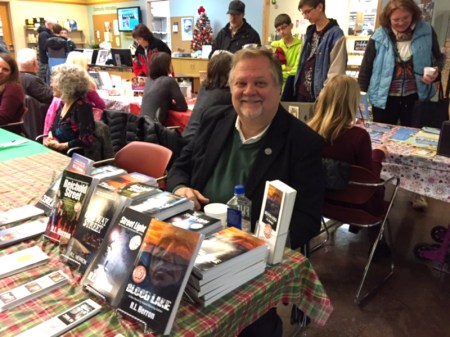
library-book-signing-2016Orion Township Library – Book Signing, December 3, 2016.

Before we really get into this, let’s agree on the term “successful.” I define it simply … your books are there, you have a place to sit and you sell a book.

Sounds nutty, right? Really, it’s not.

The Real Purpose
The purpose of a book signing isn’t to sell your books, it’s to sell yourself as an author. Any time you can sit in a library or a bookstore with your face, name and product in front of people who love to read, that’s great promotion.

For an author, a book signing can be terrifying. Believe me, I know. It’s like throwing a party and not being certain anyone will come. But there are ways around this.

Don’t do it alone. Go to signings that feature lots of other authors. With many authors in the same place, no one counts how many books you did or didn’t sell. Not even me.

Promote on your end. Tell your friends and family. Tell their friends. Make an announcement on all social media you belong to. Even if no one on your list is a local, they might have friends who are.

Dress comfortably, but nicely. “Business casual” best describes my preferred way to dress for a signing: comfortable pants, nice shirt (a sweater in the winter) and (for guys) a sport coat.

Bring stuff. I like to bring a water bottle, my business cards, lots of pens (you’d be amazed at how many people walk off with pens), and any promotional items you want to show or share.

Talk, Talk, Talk
Don’t be afraid to smile and wave and greet customers. I know it can seem scary, but please don’t sit there in a huddled lump. Talk to people. At the very least, make eye contact.

I always try a cheerful, “Hi there! What do you like to read?”

I stand often and speak to people passing the table. If someone stops and looks at the books, I put one in their hands. Not to tell them to buy it, but to make them feel comfortable picking it up and reading the back blurb.

Then I engage them in conversation about it: “This is my latest book. It’s about… ”

This may also be a good time to hand them a promotional business card or bookmark so they can pass it on to others who are interested.

I even talk to the kids.

That lady in a hurry, who doesn’t read your genre, may not ever buy your book … but she will remember you were nice and down-to-earth and will tell her friends who are avid readers that she met you.

As I said, at a book signing you’re not promoting books as much as you are selling yourself.

No act of kindness is ever wasted.

Be Observant
Observe the other authors and how they interact with the public. Check out their promotional stuff. Smile and look over their books.

Introduce yourself as a fellow author and be sure to trade marketing tips. Everything you see and hear at a book signing can be directly applied to your own efforts (or firmly crossed off as Things To Never Do Again).

I’ll tell you one more not-to-be-missed benefit of book signings: they make you feel real.

I’ve already published six books, won multiple awards, and still worry someone will write fraud on my forehead whenever I introduce myself as a writer.

But at a book signing, with your own books in front of you… well, you’re the real thing … and it’s great good fun.

At my recent signing I was approached by the local paper (who had already published my picture in the article announcing the library event) to send them information for an article about my latest book. I was also interviewed live by our local cable TV station.

I’ve been at signings where I sold more books, but the publicity from this one is going to make it a signing that’s tough to beat.

Thanks Orion Township Public Library!

**********

My books have all garnered some terrific reviews and you can see the ones I have available by using the Amazon link below. Look for them. Better yet, buy one and read it. You just might like it.

buy now amazon

You’re invited to visit my web site, BROKEN GLASS, or
like my Book of Face page. You can find me on Goodreads, or follow
some of my shorter ramblings on The Twitter.

**********

Comments posted below will be read, greatly appreciated and perhaps even answered.