A lot of people think the concept of “indie authors” is something that has come about since the development of the Internet. I’ve heard that a lot, but a little research turns up loads of evidence to the contrary.
There are many famous authors who, at some point in their careers, were all self-published. Some of the names on the list are surprising.
You’ll find such renowned authors as Mark Twain, Zane Grey, Walt Whitman, Edgar Allen Poe, Virginia Woolf, Gertrude Stein, James Joyce and D.H. Lawrence on that list. So it seems today’s Indie authors are actually carrying on a great tradition from the past … and that’s a good thing.
Even Edgar Rice Burroughs (1875-1950), as the story goes, self-published. I’m not entirely convinced the sources for that comment were right. He did publish (sort of) “Camping Out: Diary of an Automobile Camping Tour.”
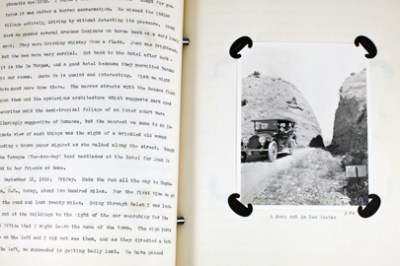
A little more than a hundred typewritten pages with photographs and original drawings by Burroughs, it was really more of a diary of his family trip, but I suppose since he had several copies printed for family and friends it counts … if you stretch credibility a little … as self-publishing.
The frontispiece even contains the humorous, and grammatically incorrect remark: “Did Into a Book by Edgar Rice Burroughs, Inc.”

One thing about his life, however, is certain: In the summer of 1911, Edgar Rice Burroughs was 35 years old, a middle-aged father of two, and he was working in a dead end job as a manager for a pencil sharpener company.
All his previous ventures had ended poorly. A bit rowdy as a youth, his wealthy father sent him to Michigan Military Academy, in Orchard Lake, Michigan, where he actually did quite well.
He tried for an appointment to West Point, but failed the entrance exam. He went to Harvard briefly, but never finished. He eventually joined the Army, but was sent home after a few years because of a temperament that didn’t deal well with the disciplinary demands.
One low-paying job followed another, and by the time he reached that point in 1911, if one had to summarize his life in a single word, “failure” might have been a good choice.
Yet, one hundred years ago this month, convinced he could write as well or better than the awful stories he read in the pulp magazines, Edgar Rice Burroughs began writing the adventure series that would make him, and his most famous fictional creation, Tarzan of the Apes, household names around the world.

“I have often been asked how I came to write,” he once commented. “The best answer is that I needed the money. When I started I was 35 and had failed in every enterprise I had ever attempted.”
Yes, “Tarzan” is pulp fiction. It overflows with theatrical prose and political incorrectness. But Burroughs also took on the nature versus nurture debate and commented on the savageness of civilized life. He once admitted to an interviewer: “I don’t think my work is ‘literature’, I’m not fooling myself about that.” Yet he wrote some of the most beloved stories of our time. His work has been translated into more than thirty languages.
Some literary characters are able to transcend their creators and endear themselves as part of our shared culture. In doing so, they become the closest thing we have to a modern mythology.
You don’t need to understand Arthur Conan Doyle, Carlo Collodi or Mary Shelley to know their creations: Sherlock Holmes, Pinocchio and Frankenstein. That’s certainly true with the most famous creation of Edgar Rice Burroughs – Tarzan, Lord of the Apes, who first appeared in print 100 years ago.
Makes me feel good about the possibilities of my own writing. I just hope I don’t have to wait a hundred years.










 Painting With Light