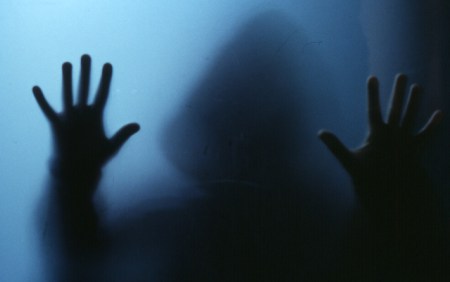
There have been a couple of dark characters in my recent books. Real monsters. It seems almost counter-intuitive, but writing about them was actually a lot of fun.
I’m sure we all think we know about monsters. They lurk in dark corners and come out when everyone is asleep. We see their shadows at the end of a street where the lamps are broken. We feel them watching us, hidden by the gloom.
A lot of people imagine aliens, ogres and demons, but you don’t have to write sci-fi or fantasy to have monsters.
For instance, when people say Stephen King is strictly a horror writer they are totally missing the point (or else they’ve never read anything he’s done). His best stories are not about monsters.
They’re about people.
Take Something Normal and Twist It
As Edgar Allan Poe said, “The scariest monsters are the ones that lurk within our souls…”
As authors, we want people talking about our characters long after they’ve read the story. We want those characters seared into our readers’ brains, making our stories unforgettable.
So how do we create characters that leave such lasting marks?
Truly terrifying fictional characters mix the trivial and mundane with the grotesque in a way that both entices and terrifies … and writers have been doing it for a long, long time.
Hesiod, in the Theogony (700BC), took an unusual old woman living alone, replaced her hair with snakes, gave her gaze the power to turn men into stone, and created the horrifying legend of Medusa.
Likewise, Horace (65BC–8BC) wrote down the oral legends about a bull with the torso of a man, living in a maze, with a craving for human flesh … and the Minotaur entered our literature.
In the modern era, an intellectual forensic psychiatrist with a taste for human flesh became the cannibalistic serial killer, Dr. Hannibal Lector, in Thomas Harris’ Silence of the Lambs.
To build such great fictional characters, those authors started with an everyday thing, then twisted it and made it memorable by adding something that makes readers almost want to turn away.
Almost … but not quite.
Play On Existing Fears
The good news is, there’s no need to create new fears when there are so many that already exist. We simply need to ask ourselves what are we afraid of? – and build the monster from there.
We usually feel safe in our churches, or in our homes behind locked windows and doors. Yet, secretly, we’re afraid our castle (or our faith) isn’t as strong as we think. Fear comes when there is something in the night that can breach our walls.
When I wrote about the insane Shadow Man in One Way Street, or the evil Micah, in Street Light, I played on this fear by having them attack people in their places of safety.
Show Us Something About Ourselves
We also need to ask ourselves what our characters say about us as a species. The very best monster characters hold up a mirror and reveal something horrible. When they do, they are truly terrifying.
H.G. Wells, in The Time Machine, used his Morlocks to show the terrible nature of social classes. His characters reveal that making some part of our society subservient, as we often do, is more than just a case of rich and poor. It’s a fundamental flaw in the character of our species … that will ultimately lead to our destruction.
Draw on your own experiences to create memorable stories. Twist normal people into outrageous beasts … and in doing so you’ll create characters that will lurk in the dark shadows of your reader’s imagination long after the book is closed.
**********
Goodreads Book Giveaway

**********
My books have all garnered some terrific reviews and you can see the ones I have available by using the Amazon link below. Look for them. Better yet, buy one and read it. You just might like it.

You’re invited to visit my web site, BROKEN GLASS, or
like my Book of Face page. You can find me on Goodreads, or follow
some of my shorter ramblings on The Twitter.
**********
Comments posted below will be read, greatly appreciated and perhaps even answered.

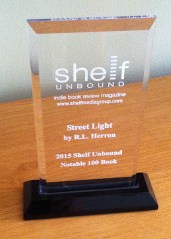 I haven’t looked back. I’ve written one book every year since, with the exception of 2013 (that year I wrote two). With one Readers Favorite Gold Medal (and one Silver), a favorable Kirkus Review, Five-Star reviews from reputable review houses for all my books, and a “Notable 100 Book for 2015” from Shelf Unbound for my novel STREET LIGHT … I’m not rich, but I’m pretty happy.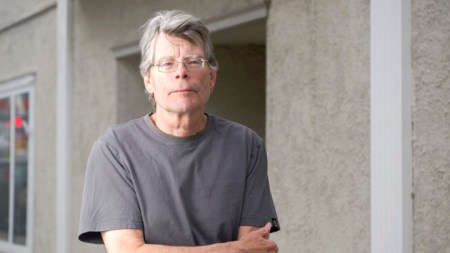






 Painting With Light