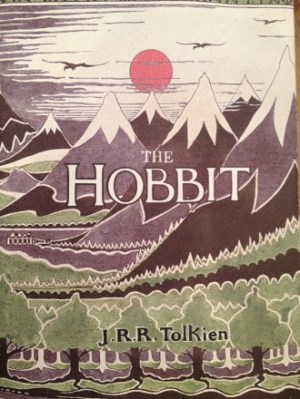
Original Cover for “The Hobbit”
The Hobbit
Yesterday (Sept. 21, 2012) marked the 75th anniversary of the publication of one of my favorite stories: J.R.R. Tolkien’s immortal adventure tale about the furry, stay-at-home, almost-human creature called Bilbo Baggins, a small, likable hobbit who was very fond of his calm, unadventurous hearth and home.
Bilbo wanted nothing more than to enjoy the quiet solitude of his cozy home in the Shire, but in order to do what’s right, this unlikely hero ventures on a quest wth 13 dwarves and a wizard named Gandalf, to retrieve treasure stolen by a dragon.
In writing The Hobbit, Tolkein changed the face of fantasy fiction forever.
John Ronald Reuel (J.R.R) Tolkien, a British professor, wrote the story for his four children and published it in 1937 with a 1,500-copy first printing. He had no way of knowing what wonderful havoc he’d wreak with this story of a reluctant hobbit’s quest.
Tolkein’s Middle-Earth is quite likely the most extensive, detailed and exhaustive fictional creation ever made. Middle-Earth was a place where there was a role for an individual hero like Bilbo Baggins.
Tolkien had already written poems and tales set in a nascent Middle-Earth. Some were penned while he was hunkered down in the trenches during World War I. That miserable war would cause him to turn to a pastoral, other-wordly place to work out his fears, hopes and dreams; a place where adventures and wars have happier results.
An easy-going and recognizable character, Bilbo was a flustered, nervous fussbudget who nonetheless craved adventure and had a hunch he might actually harbor a gallant heart.
Unlike the millions who perished in World War I for no good reason, Tolkien had Bilbo set out to risk everything to do the right thing.
Tolkein (1892-1973), a reclusive British scholar and lexicographer was, in a way, the original geek. He specialized in the rather mundane field of philology (the history of languages). He didn’t even read contemporary fiction.
He had founded literary clubs with archaic names: the Tea Club and Barrovian Society, the Kolbitars Society and the Inklings.
Tolkien hung out with fellow egghead, Middle Ages-minded pals (like C.S. Lewis, a fellow Inklings member) in pubs, where they drank ale, smoked pipes and made up stories by firelight. How very hobbit-like!
Tolkien didn’t worry whether his novels were seen as high art or bedtime stories; in fact, he was doubtful his creations would have any appeal beyond his own children and his Oxford colleagues. All he wanted, Tolkien once said, was to “open the door on Other Time” and “stand … outside time itself.”
He succeeded. The Hobbit has since been translated into more than 50 languages, sold 100 million copies worldwide and inspired hundreds of fantasy writers. And it all began 75 years ago with the opening line: “In a hole in the ground there lived a Hobbit.”
No one could have predicted how well his heroic, romantic, high fantasy would catch on.
But we are all reaping the benefits.
My own stories should be so lucky.
The Trailer for the Upcoming New Movie: “The Hobbit”









 Painting With Light