
I gave up making New Year resolutions a long time ago. Couldn’t see the sense in any of it. I never managed to keep most of them anyway, despite my best intentions.
The only one I ever came close to keeping was my promise to go on telling stories, as long as I could. The artistic side of me knew I could keep that one.
I’ve always doing enjoyed creative things, and the ancient art of storytelling is especially well suited to artistic exploration. No special equipment is needed beyond the ability to use words, and a whole lot of imagination.
In our fast-paced, media-driven world today, storytelling can be a nurturing way to remind people that mere words are themselves powerful, that listening is always important, and that meaningful communication between people is an art.
I continue to practice my storytelling. I’m about 25,000 words deep into the third book of my Reichold Street trilogy, but I’ve hit one of those moments when I just want to walk away for a while and give the characters a chance to tell me where it’s going.
So, I tried something else.
I wrote the following little story in about 15 minutes last night. It’s short enough to be something I’d do at a reading, which may be the best way to hear it. A couple of people have told me it’s a very emotional piece. I’d love to know what you think of it.
==========
Holiday Lights
© R.L. Herron
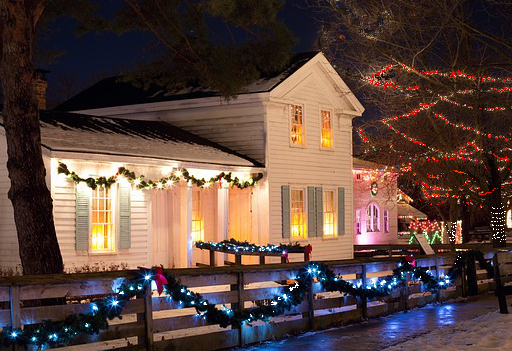
I flipped the switch and watched the red and white twinkling lights go on outside. White lights wrapped around the trunk of the tree; red ones in the branches.
I liked the twinkling lights. They reminded me of Caroline. She had always enjoyed the holidays and the lights.
“Put some in the front,” she had cajoled me one year. “I think the white ones would be pretty draped over the railing.”
So, even though the thermometer had barely made it to seven that day, I waded through the snowdrifts and draped white twinkling lights over the rail.
“Perfect,” she said.
Caroline laughed when I plugged them in, and clapped her hands together like a little girl. Her blue eyes sparkled and she danced. Suddenly I didn’t feel so cold any more. I had made her happy, and that meant a lot. That meant everything.
I still put the lights out front every year, red over white, just like she wanted, even though it was getting harder for me to reach the higher branches on the tree.
Maybe I’ll skip that last strand, I thought, although I knew I wouldn’t. I’d wrestle the ladder around and use one of those ‘grabby-things’ to help me reach the top branches, no matter how long it took.
It didn’t matter how cold it was, or how much snow had fallen. Every year it was worth it. Once the lights were on, I felt good and warm again, even if I was still standing outside in the snow.
The holidays were over now, but I still turned on the lights. Just one more night. I knew when the time came to finally turn them out for the year the happy memories of my Caroline would once again slip into the shadows, and I wanted them that one night more.
My neighbor, Mike, walked over as I went down the driveway to get the paper.
“Pushing the holiday a bit, aren’t you John?”
“What’s wrong with a few lights?” I asked.
“It’s January twentieth,” Mike said. “Christmas has been over almost a month.”
“January twentieth?”
“Yeah, John, everyone’s getting ready for Valentine’s Day and the stores are already pushing Easter.”
I knew Mike would never understand why the lights were so important to me. “Well,” I said, “Just one more night won’t hurt anything, will it?”
The look he gave me was one of resignation. “John, as far as I’m concerned you don’t ever have to take them down … but the holiday is over and it looks a little silly.”
“I guess you’re right, Mike,” I said. “Just one more night.”
He sighed, and I could tell he was thinking “Silly old man” as he trudged back up his own driveway shaking his head. I watched him until he disappeared into his garage and the door started down.
I didn’t go inside right away, even though my breath left frosty plumes in the air. I stood at the end of the driveway and admired the lights, remembering how much Caroline had enjoyed them. It seemed hard to believe she’d been gone already for three years.
I missed her terribly every day, but she seemed so much closer when those twinkling lights were in the tree and on the rail that I was like a little kid, filled with excitement, when I put them up. I hated to take them down.
“See, Caroline,” I’d say when I’d wrestled the boxes out of the attic, “the lights are going up again.”
When they were strung and I threw the light switch, I’d stand there looking at them from the same spot in the living room she’d always stood to admire them. I always felt good at that moment.
Then, every night, when I turned them on again, I’d say those words to her, even though she wasn’t there.
“See, my love, the lights are on again.”
The wind picked up and blew the chill air around my scarf and down my neck. I shivered, and knew it was time to get back inside, but I stopped near the front door to look once more at the lights … and at the empty spot inside the front window where she used to stand.
The lights had always made her so happy, and I was happy, too, when she was.
It felt wrong to want to cry.
* * *
**********
My books have garnered some terrific reviews. You can see the stories I have available by using the Amazon link below.

You’re also invited to visit my web site, BROKEN GLASS, or like my Book of Face page. You can also follow my shorter ramblings on The Twitter.
**********
Comments posted below will be read, greatly appreciated and perhaps even answered.
 THE RESERVE BEACH IN PUNTA CANA © R.L. Herron







 Painting With Light