Archive for the ‘Storytelling’ Category

Is This the Year of the Writer?

January 1, 2018


New Year’s Day is the time most of us reflect on the past year, while thinking about the goals and hopes for the new year ahead.

I had a fabulous 2017.

My books are still getting great reviews and winning awards.

I reconnected with some dear, old friends, had several successful book-signings and attended two writing conferences. I visited my grandkids in south Florida, and vacationed on the island birthplace of Alexander Hamilton (Nevis).

I ended the year with friends watching my beloved Detroit Red Wings pull off a shoot-out win in their new downtown facility … which we followed with a much-coveted locker room tour.

I’m making my usual resolutions: Lose weight, exercise more and eat more sensibly. As I get older, these become more important to getting healthier, which will, hopefully, let me get a LOT older (although, sadly, I often forget them by February).

But what does it mean as a writer?

For me, that part of my resolution is the same as it’s been for many years now … I’m hoping 2018 is the year I finish another novel.

For you, your resolution may be to make this the year you commit to a sustainable writing habit … or, maybe, make this the year you finally get published.

Here are four resolutions you can make to improve your writing to start the New Year. Pick one to start, or dive in with all of them. The result may be the best writing you’ve done yet.

Make Time for Writing
If you seriously want results as an author, you have to put your butt in the chair and write.

Wanna-be writers hear this all the time but, if you’re like most of them, you’ll come back with the fact you have jobs, kids, chores and other outside interests that take away from your writing time.

Most of you will add there are only 24 hours in the day to attend to these many responsibilities … and you also need to sleep.

But I say excuses are easy to make. There’s always time to write.

Think about it this way: If you’re only able to write for one hour a day, accomplishing only 500 words in that hour, you’ll have written about 15,000 words in a month. Even if only half of those words are usable, if you keep it up for a year, you’ll have written 90,000 words.

And that, my friend, is a novel.

Most, if not all of us, have at least one hour of quiet time a day to devote to our writing. And don’t think that writing time means just typing words into a blank Word document. Reading, research and writing exercises are also great ways to spend your time, because they move you toward your writing goals.

Embrace Your Personal Writing Style
I’ve talked about this before, too. You either outline everything first, or you fly by the seat of your pants.

Outliners are often much more organized, but their rigid structures sometimes get in the way of lightning-rod flashes of creativity.

Pantsers are much freer in their writing methodology, preferring to “make it up as they go” rather than adhere to a strict outline they write ahead of time. They often find surprises as they write, and they also tend to feel less inclined to “stick to a plan” … because they don’t necessarily have one.

But I’ll say it again: There’s nothing wrong with being either a Pantser or an Outliner. Both will get the job done if you work at it.

Step Outside Your Comfort Zone
Some of us are fiction writers and aspiring novelists. Some of us are memoirists. Some of us are a combination of all of these, in varying degrees. But all of us have a comfort zone, and if we stay within it too long, we risk stagnation.

So, resolve to step outside of your comfort zone. Experiment with styles and voices you’re not used to. Emulate authors you don’t normally read. Read books you wouldn’t normally pick up off the shelf.

If you’re strictly a fiction writer, branch out into the world of freelance articles, where science and special interest articles provide great fodder for new stories.

If you write nonfiction, study plot, structure, voice and pacing, all of which will help you write tightly wound, concise pieces with distinct tones.

My point is, we all get stuck in a rut from time-to-time. Actively finding ways to get unstuck is the mark of a great writer.

Call Yourself a Writer
This may be the most important resolution you make for 2018. It is for me every year.

You may think you can just dabble in this stuff and it might work out in the end. But being a writer isn’t a short journey. It’s a lifetime of work that takes a tremendous amount of effort to reap rewards.

Acknowledging your writerly status is one thing; living it is another.

2018 can be what you’re waiting for … your year for writing. Start calling yourself a writer.

Then make the most of it.

**********

My books have all garnered some terrific reviews, and you can see the ones I have available by using the Amazon link below. Look for them. Better yet, buy one and read it. You just might like it.

buy now;

**********

You’re invited to visit my website, BROKEN GLASS, or
like my Book of Face page. You can find me on Goodreads, or follow some of my shorter ramblings on The Twitter.

**********

Visit my web site to hear the remarkable radio interview about my novel “Blood Lake” by The Authors Show.

**********

Comments posted below will be read, greatly appreciated and perhaps even answered.

Books at Holiday Time

December 14, 2017


Photo Courtesy of Pixabay.

It’s that time of year again. In my neighborhood, holiday decorations are up, houses glow with lights, and the stores are crowded (which I take as a good sign). It’s also a time when we all think again about songs and stories based on the holidays.

Maybe it’s just the writer in me, but I also think about books.

One of my favorites is A Christmas Carol, by Charles Dickens. It’s undoubtedly one of the best-loved (and best-selling) tales in English literature. It’s been a holiday classic since its original publication almost exactly one-hundred-seventy-four years ago.

The story explored not only Scrooge’s redemptive journey, but the lives of the poor majority surrounding him. Inspired by his own rocky childhood, historians say Dickens was writing an indictment of 19th century industrial capitalism, and the disparity between the poor and the wealthy in early Victorian-era Britain.

He used the stingy-old-man character named Scrooge as a means of highlighting the need to return to traditional Christmas values, family togetherness and charity.

It’s a message we could all stand to hear again.

I was surprised to learn the classic only took Dickens six weeks to write. Published in London by Chapman and Hall on December 19, 1843, it was an immediate success with the public. The initial print run of 6,000 copies sold out by Christmas Eve.

However, for its author, it was a grave financial disappointment.

Dickens insisted on a lavish format for what was to become the most famous of his holiday books.

He wanted A Christmas Carol to be a beautiful little gift book, and as such he stipulated a fancy binding stamped with gold lettering on the spine and front cover; gilded edges on the paper all around; four full-page, hand-colored etchings and four woodcuts.

Examining preliminary copies, Dickens decided he disliked the color of the title pages, and found the end papers smudged when touched.

He called for immediate changes and by December 17, two days before the book’s official release, the publisher had produced new copies, coupled with a number of significant textual corrections, which pleased the young author.

Dickens, who was still optimistic about sales, set the price of the book reasonably to encourage the largest possible number of purchasers. He hoped more sales would bring in larger profits, relieving some of his financial obligations.

You see, in order to get the story published fast, Dickens had agreed to an unprecedented publishing arrangement: he would assume all of the costs of the initial publication but, in doing so, would also gain all of the profits.

Dickens was initially elated with the public’s overwhelming response. But the cost of producing the book was so high that once expenses were tabulated, there was very little left over for the author himself.

When Dickens received the production receipts from Chapman and Hall, he found after the deductions for printing, paper, drawing, steel plates, engraving, coloring, binding, advertising and a commission to the publishers, the balance to his credit was only one-tenth of what he imagined, and far too little to live on.

“The truth,” wrote Dickens friend and literary adviser, John Forster, “was that the price charged was far too little.”

It’s interesting to note, despite the profitability shortfall, by February of 1844, less than two months after the book’s appearance, at least eight theatrical versions of A Christmas Carol were already in production. Since then, there have been literally hundreds more adaptations for stage, radio, television, and film.

The public loved it. The tale of one man’s redemption interwoven with Victorian Christmas traditions morphed into every publisher’s dream. The book has never been “out of print.”

I find it to be no small irony that for this instantly classic Christmas tale of greed and beneficence, Dickens received none of the millions Tiny Tim and Ebenezer Scrooge continue to generate every year.

**********

My books have all garnered some terrific reviews, and you can see the ones I have available by using the Amazon link below. Look for them. Better yet, buy one and read it. You just might like it.

buy now;

**********

You’re invited to visit my website, BROKEN GLASS, or
like my Book of Face page. You can find me on Goodreads, or follow some of my shorter ramblings on The Twitter.

**********

Visit my web site to hear the remarkable radio interview about my novel “Blood Lake” by The Authors Show.

**********

Comments posted below will be read, greatly appreciated and perhaps even answered.

Book Signing

December 2, 2017


Nevis at Sunset.

Last October, I attended the 10th Annual Rochester Writers’ Fall Conference. As always, I got a lot out of it. The host, Michael Dwyer, can be counted on to put together a good assortment of presentations for the day.

I meet a lot of interesting people, too. Ambitious indie-authors who, like me, want to learn everything they can in order to get their book to the next level. Their collective enthusiasm is always contagious, and I often learn as much from other participants as I do from presenters.

We’ve all experienced a combination of no-motivation days, beautiful sentences, writing blocks, sudden inspiration, painful editing days, re-writes, boosts of self-confidence and bouts of insecurity. Hanging out with fellow authors – people who truly get you – is fortifying.

There are many opportunities to get inspired, and even to get a keener sense of your own writing projects. By the end of a writers’ conference, attendees inevitably experience an endorphin high. Capitalizing on this state of excitement is crucial.

You will probably not feel more stoked than you do on the way home from a writers’ conference. Let that work for you. While some people feel light-headed from all the information, I say do something about it immediately! It will feel productive to have taken a first step, and even the smallest adjustment could create momentum.

Some of the ideas at a conference will strike a chord with you, others will not be right for your projects. Take the time to figure out what feels right. Allow yourself to get excited about small victories. That way you are enjoying the journey and staying engaged, instead of feeling burned-out or overwhelmed.

I used the good feeling to re-visit my website and make some much-needed adjustments!

However, to tell the truth, my batteries needed recharging and I waited a month to do it … taking some time to really think about it during a much-needed vacation with my eldest son and his family.


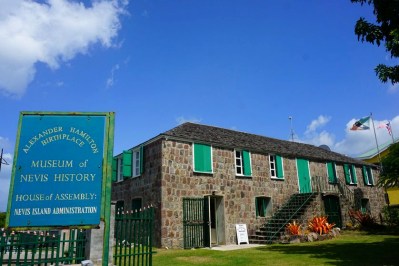
Birthplace of Alexander Hamilton on Nevis.

That’s exactly what I did on the beautiful Caribbean island of Nevis. I had a successful book-signing just before we left, and I have another one scheduled with other local authors at the Orion Township Library on Saturday, December 9 (from 1:00-4:00). During my time off, I uncharacteristically did no writing at all.

It worked. My writing block is gone and ideas abound.

Hopefully, it will be a fast and glorious road now to my next book, taking one step at a time.

**********

You’re invited to visit my website, BROKEN GLASS, or
like my Book of Face page. You can find me on Goodreads, or follow some of my shorter ramblings on The Twitter.

**********

Visit my web site to hear the remarkable radio interview about my novel “Blood Lake” by The Authors Show.

**********

Comments posted below will be read, greatly appreciated and perhaps even answered.