Archive for the ‘Book Trailer’ Category

I Didn’t Always Write Fiction

December 6, 2012

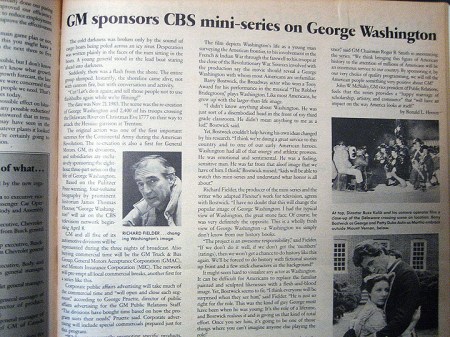
G. Washington Article An Article Written for the December 1983 Issue of “GM Today” © R.L. Herron

The headline of today’s entry is somewhat misleading. I’ve actually written fiction (and poetry) since I was seventeen. Most of it, with the exception of a couple of short stories and some poems, never saw the light of day in any publication.

In fact, most of it never even garnered a rejection slip.

Just like with today’s wannabe authors, rejections were not acknowledged … they were ignored. Somewhere, in a dusty brown cardboard box in the dim recesses of the basement, I’m sure I still have copies of most of the ones I did get. Sad, yellow-brown pages brittle now with age.

There were a few mimeographed (read xeroxed, for those too young to remember mimeos) and unsigned rejection letters, but those were infrequent and have long since been tossed into the same abyss my original submissions went into.

However, I did write and publish:

    The cold darkness was broken only by the sound of cargo boats being poled across an icy river. Desperation was written plainly in the faces of the men sitting in the boats. A young general stood in the lead boat staring ahead into darkness.

    Suddenly, there was a flash from shore. The entire group slumped. Instantly the shoreline came alive, not with cannon fire, but with conversation and activity.

    “Cut! Let’s do it again; and tell those people not to use flashbulbs again while we’re filming!”

The date was November 21, 1983. The scene was the re-creation of George Washington and 2,400 of his troops crossing the Delaware River on Christmas Eve 1777 on their way to attack the Hessian garrison at Trenton.

The original action was one of the first important victories for the Continental Army during the American Revolution. The re-creation is also a first for General Motors.

I found this example of one of my articles, published in the December 1983 issue of “GM Today” … an internal monthly newsletter distributed to all GM employees. The print run, at the time, was over 800,000, quite a respectable distribution. I remember this article very well.

The editor didn’t like it at all.

He’d sent me to cover a portion of the filming of the GM-sponsored made-for-television mini-series about the life of the young George Washington, starring Barry Bostwick and Patty Duke. I met and interviewed them both … and the director, Richard Fielder, on location at the filming of the re-creation of Washington’s historic crossing.

From his comments when I returned, my editor thought the article was too story-like and not the nuts-and-bolts information he wanted. Thankfully, the PR Vice President had seen … and liked … my article or it would have found its way into the waste receptacle, too.

Is the world today better simply because the article ran almost exactly as I wrote it?

Probably not. But my memory of it is.

“Reichold Street” a book trailer video © R.L. Herron
 

Now, Back to Business …

November 30, 2012

Lots of Questions
One of the things I’ve noticed since I won that pesky Gold Medal for my debut novel, Reichold Street: I’m now asked (usually by other writers, when they find out about the award) how I went about creating the book.

Did you do anything unique or special when you wrote? How, exactly, did you go about it? Did you create extensive review notes for all your characters? Did you make an outline? Did you follow any particular plot style?

The answer to all these questions is … no.

Oh, for a long time I tried to follow all the language rigors most teachers (who, by the way, were quite often not writers themselves) tried so hard to drum into me while I was in school all those years ago. Start with notes. Decide on a plot line. Make an outline.

The trouble is, it didn’t work (sorry, Mrs. Bliss).

My prose was always stilted and quite unbelievable. For a while, I tried making extensive Excel spreadsheets for each character. I would make detailed lists of their traits, physical descriptions, even notes about siblings and significant others.

I was doing this for every character in every story. It was far too tedious and the result was awful.

I finally found a Word-compatible piece of software called Scrivener – which, as recently as a few months ago I touted at the meeting of a local writers group I attend.

In truth, it was just another form of boring spreadsheet.

In Miami a few weeks ago I was asked once again by other writers: “Your characters are very well-developed … how do you go about writing?” and it occurred to me I had actually employed none of those approaches in crafting Reichold Street.

Oh, I admit I toyed with them … sort of. I plugged information into spreadsheets and also tried to coax software to help develop my storyline, instead of just letting the story happen.

But it was (as it has always seemed to be) a tedious, cumbersome and unwieldy process – one that always left me with, as you might imagine, predictably shitty results.

I realized it wasn’t until I let all that go and started relying on my intuition to tell me what was working in the story that Reichold Street started to come together.

Creative Spontaneity
Stephen King mentions in his fabulous book “On Writing” that “plotting and the spontaneity of real creation aren’t compatible.” I’ve come to believe that’s true.

My writing style is really quite simple. I start with what I think is an intriguing (at least to me) what-if? question. Then I try to visualize what begins to happen.

Rather than going to the story, I let the story come to me. I see the surroundings; I hear the characters.

Then I try to translate what I see and hear in my mind into words on the page, and go forward from there.

Does it work? Some people seem to think so, but I guess reviews are one thing and people making purchases are quite another. From the proceeds so far I can afford lunch out once in a while. Not exactly world changing.

The months spent writing the book have started to seem like a breeze. Even the hard part of editing now seems easier in hindsight. I’ve discovered getting the word out is the hard part.

If you have the time, please check out the book trailer for “Reichold Street”

An Interesting Author … Paul Michael Glaser

November 29, 2012


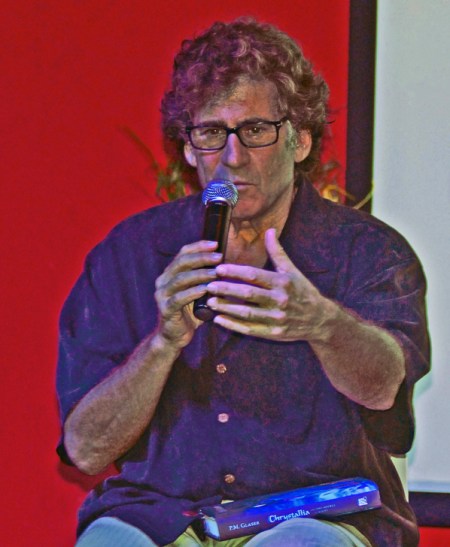
Paul Michael Glaser Speaking to the Readers Favorite Audience

One of the speakers at the 2012 Readers Favorite Award Ceremony was actor/director Paul Michael Glaser (he also won a well-deserved Silver Medal for his young person’s fantasy story, Chrystallia).

He’s perhaps best known for his role as Detective David Starsky in Starsky & Hutch, a popular television series in the 70s, where he played Detective David Starsky opposite David Soul for four seasons (1975-1979) on ABC.


Glaser later served as Chairman of the Board of the Elizabeth Glaser Pediatric AIDS Foundation – a nonprofit organization established by his wife Elizabeth after she, and their children, were diagnosed with HIV contracted from a blood transfusion. He was Chairman of the Board for six years and now serves as Honorary Chairman.

With over four decades in the film/television industry, Glaser has now turned his attention to his latest project, Chrystallia and the Source of Light, a story that follows two children who stumble upon a magical underground kingdom, where everything and everyone are made of minerals and crystals.

The children, Maggie and Jesse, discover the only way for them to get back home is to find the source of light, which Jesse believes will also save their dying mother.

In my conversation with him, Paul pointed out his beautifully self-published book, which is an interesting read for anyone, is intended for the 9-to-14 age group, as his way of instructing children to learn to cope with their fears.

A portion of the book’s proceeds also go to the Elizabeth Glaser Pediatric AIDS Foundation.

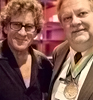
I told Paul I blog about writing and promised I would write a blog about Chrystallia, and encourage people to try it.

And now I have.

Tomorrow I will return with another blog about the craft of writing.