Archive for the ‘Storytelling’ Category

75 Years Ago Yesterday

September 22, 2012


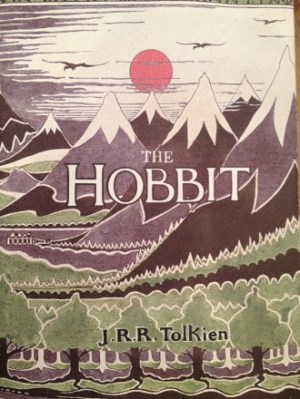
Original Cover for “The Hobbit”

The Hobbit

Yesterday (Sept. 21, 2012) marked the 75th anniversary of the publication of one of my favorite stories: J.R.R. Tolkien’s immortal adventure tale about the furry, stay-at-home, almost-human creature called Bilbo Baggins, a small, likable hobbit who was very fond of his calm, unadventurous hearth and home.

Bilbo wanted nothing more than to enjoy the quiet solitude of his cozy home in the Shire, but in order to do what’s right, this unlikely hero ventures on a quest wth 13 dwarves and a wizard named Gandalf, to retrieve treasure stolen by a dragon.

In writing The Hobbit, Tolkein changed the face of fantasy fiction forever.

John Ronald Reuel (J.R.R) Tolkien, a British professor, wrote the story for his four children and published it in 1937 with a 1,500-copy first printing. He had no way of knowing what wonderful havoc he’d wreak with this story of a reluctant hobbit’s quest.

Tolkein’s Middle-Earth is quite likely the most extensive, detailed and exhaustive fictional creation ever made. Middle-Earth was a place where there was a role for an individual hero like Bilbo Baggins.

Tolkien had already written poems and tales set in a nascent Middle-Earth. Some were penned while he was hunkered down in the trenches during World War I. That miserable war would cause him to turn to a pastoral, other-wordly place to work out his fears, hopes and dreams; a place where adventures and wars have happier results.

An easy-going and recognizable character, Bilbo was a flustered, nervous fussbudget who nonetheless craved adventure and had a hunch he might actually harbor a gallant heart.

Unlike the millions who perished in World War I for no good reason, Tolkien had Bilbo set out to risk everything to do the right thing.

Tolkein (1892-1973), a reclusive British scholar and lexicographer was, in a way, the original geek. He specialized in the rather mundane field of philology (the history of languages). He didn’t even read contemporary fiction.

He had founded literary clubs with archaic names: the Tea Club and Barrovian Society, the Kolbitars Society and the Inklings.

Tolkien hung out with fellow egghead, Middle Ages-minded pals (like C.S. Lewis, a fellow Inklings member) in pubs, where they drank ale, smoked pipes and made up stories by firelight. How very hobbit-like!

Tolkien didn’t worry whether his novels were seen as high art or bedtime stories; in fact, he was doubtful his creations would have any appeal beyond his own children and his Oxford colleagues. All he wanted, Tolkien once said, was to “open the door on Other Time” and “stand … outside time itself.”

He succeeded. The Hobbit has since been translated into more than 50 languages, sold 100 million copies worldwide and inspired hundreds of fantasy writers. And it all began 75 years ago with the opening line: “In a hole in the ground there lived a Hobbit.”

No one could have predicted how well his heroic, romantic, high fantasy would catch on.

But we are all reaping the benefits.

My own stories should be so lucky.

The Trailer for the Upcoming New Movie: “The Hobbit”


Is Reading in Decline?

September 5, 2012


The Next Generation Reader

While parts of the publishing industry are in crisis, Americans are reading more … at least according to the National Endowment for the Arts’ study, “Reading on the Rise.”

In stark contrast to the downward reading trend some say has characterized the past two decades, that NEA study found the first recorded rise in American reading in 26 years. Great news, certainly.

With Amazon, Nook, Sony, i-Pad and others battling to sell you an ebook reader, reading does not seem to not be in the perilous straits some naysayers might want you to believe.

Bowker, the global leader in bibliographic information (think ISBN numbers), released its 2010 annual report on U.S. book publishing, it projected traditional U.S. print output to increase to 316,480 titles.

It is the non-traditional sector, however, that continues its explosive growth, increasing to an amazing 2,776,260 titles … many created by presses catering to self-publishers, such as me.

When I first got my Kindle it was at a time I had always stated I was determined never to replace a printed book with an electronic version. I’d always found pleasure in the look and feel of a book. I still do.

I’m finding, however, that purchasing and reading electronic books is just so … well … convenient. When traveling I always carried three or four books, or more, along with magazines. I might have taken more (I’m a voracious reader) but it was quite a burden.

Now, when I travel, I have all my reading in one small, simple place. On my Kindle. So has this electronic revolution led to the demise of reading? Probably not. Certainly not in my case.

Hopefully, it will encourage people for generations to come to read the good novels already out there, and the great ones yet to be published. What e-Book readers may do is change the industry that has developed around publishing books in print.

I know a lot of people who would prefer to have a paper book in their hands rather than a machine. For a long time, I was one of them.

However, with the ability to buy books on the go and store hundreds of them on an eBook reader rather than a huge bookshelf in your house, there are a lot of positives for people to take from eBook technology and this attitude is becoming less frequent.

Some people will undoubtedly be sad to see the little bookshop they’ve visited all their life disappear, because the demand for ink-on-paper is no longer there. I’ll be one of them. In this sense the e-Book reader is leading to a demise in traditional publishing, but it’s important to remember … people are still reading!

The e-Book reader has both positive and negative effects on the industry surrounding publication, but I have no doubt it will encourage people to continue reading for many years to come.

At the same time, it may knock apart the industry that produces, promotes and sells printed books. So they scream about the demise of books and the decline of reading.

Every generation rewrites an epitaph for the book; all that changes is the culprit. In the late 1700s, French visionary Louis-Sébastien Mercier predicted that by 2440, the sprawling bookstacks of the Royal Library would be condensed into a single volume.

History proved him right in everything but his timing. The future lay not in expanding information, but in compacting it; scaling it somewhere between an iPod and an iPad.

Over two billion people now have Internet access. So the idea of putting ink on paper may well be an antiquated notion. Quaint, from a previous era, like the horse and buggy.

Still, there is something comforting about the physical experience of bookstores. The serendipity of picking up something you never thought about, just because it was on a display, is irreplaceable.

Or, perhaps what I will certainly miss most dearly, should it come to pass, is the ability to just sit and look at the other human beings around you. And, best of all, have an occasional chance conversation with one … in real time, not on the Internet, but face-to-face.


Serendipity

August 25, 2012


“Grand Haven Lighthouse”  Photo © R.L. Herron

I photograph this area often. My catalog of pictures of the lighthouse and pier in Grand Haven numbers in the hundreds … and that’s just the good ones I kept.

When I came across this one (I think I may have used it in my blog before) I was struck, not by the nice positioning of the sunset, but by the silhouette of the couple on the beach.

I was, after all, trying to get the sunset shot. My camera was set up on a weighted tripod on the beach, and I was very careful to compose the long line of the pier while I waited for the sun to go down in that precise spot.

It was difficult to do with the lens stopped down for the greatest depth of field. Everything in the viewfinder was dark … except for that bright spot of the sun.

I was busy watching the sunset, waiting for the right moment to depress the cable release I was using to minimize camera-shake, and I didn’t see the couple walking in the dark shadow of the beach.

But the serendipity of that moment was beautiful. That couple, in that exact location, at the very moment I tripped the shutter, was what made the picture for me.

I find writing a lot like that, too. I try to remember all the things I mention on my writing web site: let the characters explain the scene; make them believable, even in unbelievable situations and let the story create something entertaining.

I don’t write the way the teachers tried to pound into my head through high school, college and graduate school. There’s no outline. At most, I have a few lines of notes; a phrase that keeps bubbling up in my mind; a “what-if” thought; the memory of a delightful conversational moment I happened to overhear.

I start writing and let the story tell me what it what it wants to say. My characters drive the tale, and the serendipity of that; the faculty or phenomenon of finding valuable or agreeable things not sought for … is always a delight.