Archive for the ‘Book Review’ Category

75 Years Ago Yesterday

September 22, 2012


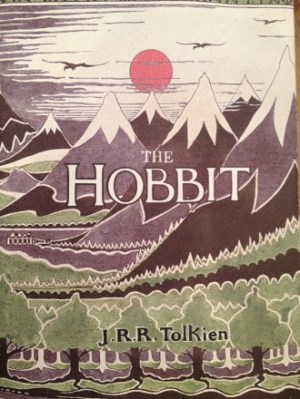
Original Cover for “The Hobbit”

The Hobbit

Yesterday (Sept. 21, 2012) marked the 75th anniversary of the publication of one of my favorite stories: J.R.R. Tolkien’s immortal adventure tale about the furry, stay-at-home, almost-human creature called Bilbo Baggins, a small, likable hobbit who was very fond of his calm, unadventurous hearth and home.

Bilbo wanted nothing more than to enjoy the quiet solitude of his cozy home in the Shire, but in order to do what’s right, this unlikely hero ventures on a quest wth 13 dwarves and a wizard named Gandalf, to retrieve treasure stolen by a dragon.

In writing The Hobbit, Tolkein changed the face of fantasy fiction forever.

John Ronald Reuel (J.R.R) Tolkien, a British professor, wrote the story for his four children and published it in 1937 with a 1,500-copy first printing. He had no way of knowing what wonderful havoc he’d wreak with this story of a reluctant hobbit’s quest.

Tolkein’s Middle-Earth is quite likely the most extensive, detailed and exhaustive fictional creation ever made. Middle-Earth was a place where there was a role for an individual hero like Bilbo Baggins.

Tolkien had already written poems and tales set in a nascent Middle-Earth. Some were penned while he was hunkered down in the trenches during World War I. That miserable war would cause him to turn to a pastoral, other-wordly place to work out his fears, hopes and dreams; a place where adventures and wars have happier results.

An easy-going and recognizable character, Bilbo was a flustered, nervous fussbudget who nonetheless craved adventure and had a hunch he might actually harbor a gallant heart.

Unlike the millions who perished in World War I for no good reason, Tolkien had Bilbo set out to risk everything to do the right thing.

Tolkein (1892-1973), a reclusive British scholar and lexicographer was, in a way, the original geek. He specialized in the rather mundane field of philology (the history of languages). He didn’t even read contemporary fiction.

He had founded literary clubs with archaic names: the Tea Club and Barrovian Society, the Kolbitars Society and the Inklings.

Tolkien hung out with fellow egghead, Middle Ages-minded pals (like C.S. Lewis, a fellow Inklings member) in pubs, where they drank ale, smoked pipes and made up stories by firelight. How very hobbit-like!

Tolkien didn’t worry whether his novels were seen as high art or bedtime stories; in fact, he was doubtful his creations would have any appeal beyond his own children and his Oxford colleagues. All he wanted, Tolkien once said, was to “open the door on Other Time” and “stand … outside time itself.”

He succeeded. The Hobbit has since been translated into more than 50 languages, sold 100 million copies worldwide and inspired hundreds of fantasy writers. And it all began 75 years ago with the opening line: “In a hole in the ground there lived a Hobbit.”

No one could have predicted how well his heroic, romantic, high fantasy would catch on.

But we are all reaping the benefits.

My own stories should be so lucky.

The Trailer for the Upcoming New Movie: “The Hobbit”
 

Transcending Indie

August 9, 2012

A lot of people think the concept of “indie authors” is something that has come about since the development of the Internet. I’ve heard that a lot, but a little research turns up loads of evidence to the contrary.

There are many famous authors who, at some point in their careers, were all self-published. Some of the names on the list are surprising.

You’ll find such renowned authors as Mark Twain, Zane Grey, Walt Whitman, Edgar Allen Poe, Virginia Woolf, Gertrude Stein, James Joyce and D.H. Lawrence on that list. So it seems today’s Indie authors are actually carrying on a great tradition from the past … and that’s a good thing.

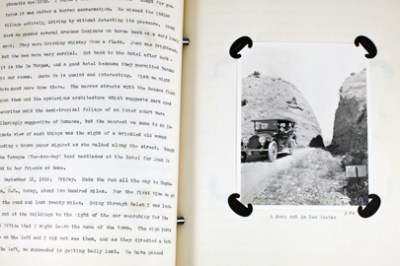
Even Edgar Rice Burroughs (1875-1950), as the story goes, self-published. I’m not entirely convinced the sources for that comment were right. He did publish (sort of) “Camping Out: Diary of an Automobile Camping Tour.”

ER Burroughs "Self-Published" Book

A little more than a hundred typewritten pages with photographs and original drawings by Burroughs, it was really more of a diary of his family trip, but I suppose since he had several copies printed for family and friends it counts … if you stretch credibility a little … as self-publishing.

The frontispiece even contains the humorous, and grammatically incorrect remark: “Did Into a Book by Edgar Rice Burroughs, Inc.”

One thing about his life, however, is certain: In the summer of 1911, Edgar Rice Burroughs was 35 years old, a middle-aged father of two, and he was working in a dead end job as a manager for a pencil sharpener company.

All his previous ventures had ended poorly. A bit rowdy as a youth, his wealthy father sent him to Michigan Military Academy, in Orchard Lake, Michigan, where he actually did quite well.

He tried for an appointment to West Point, but failed the entrance exam. He went to Harvard briefly, but never finished. He eventually joined the Army, but was sent home after a few years because of a temperament that didn’t deal well with the disciplinary demands.

One low-paying job followed another, and by the time he reached that point in 1911, if one had to summarize his life in a single word, “failure” might have been a good choice.

Yet, one hundred years ago this month, convinced he could write as well or better than the awful stories he read in the pulp magazines, Edgar Rice Burroughs began writing the adventure series that would make him, and his most famous fictional creation, Tarzan of the Apes, household names around the world.

“I have often been asked how I came to write,” he once commented. “The best answer is that I needed the money. When I started I was 35 and had failed in every enterprise I had ever attempted.”

Yes, “Tarzan” is pulp fiction. It overflows with theatrical prose and political incorrectness. But Burroughs also took on the nature versus nurture debate and commented on the savageness of civilized life. He once admitted to an interviewer: “I don’t think my work is ‘literature’, I’m not fooling myself about that.” Yet he wrote some of the most beloved stories of our time. His work has been translated into more than thirty languages.

Some literary characters are able to transcend their creators and endear themselves as part of our shared culture. In doing so, they become the closest thing we have to a modern mythology.

You don’t need to understand Arthur Conan Doyle, Carlo Collodi or Mary Shelley to know their creations: Sherlock Holmes, Pinocchio and Frankenstein. That’s certainly true with the most famous creation of Edgar Rice Burroughs – Tarzan, Lord of the Apes, who first appeared in print 100 years ago.

Makes me feel good about the possibilities of my own writing. I just hope I don’t have to wait a hundred years.


Came the Dreamweaver

August 3, 2012

OK, I admit it. I’m overdoing the Ray Bradbury bit, but his wonderful stories were part of what drew me into writing in the first place. My wife even thinks some of my stories sound decidely Bradbury-esque.

I think she’s goofy, but I’m secretly pleased at the comparison.

When I realized he had passed, I looked at the body of work he had created (most of which I own) and realized there was one I had not seen. So I bought it, and I just finished reading “Farewell Summer” – the 2006 sequel to his 1957 classic “Dandelion Wine.”

Perhaps it was just me, but I was disappointed.

It seemed like something left out of the original … which it undoubtedly was … and I think the original was stronger without it. Or could it be I was sorry for myself, realizing this writer of dreams was gone?

Bradbury’s writing ranged from fantasy to horror and mystery to humor. He scripted John Huston’s film version of Moby Dick and wrote for The Twilight Zone and other television programs. He was involved in many futuristic projects, including the 1964 New York World’s Fair and Spaceship Earth at Walt Disney World in Florida.

His book, The Martian Chronicles, was a series of intertwined short stories that satirized capitalism, racism and superpower tensions … a Cold War morality tale in which imagined lives on other planets serve as commentary to human behavior on Earth.

Fahrenheit 451, an apocalyptic narrative, prophesized the banning of books and it became a futuristic classic often taught alongside George Orwell’s 1984 and Aldous Huxley’s Brave New World.

He received a special Pulitzer Prize in 2007 “for his distinguished, prolific and deeply influential career as an unmatched author of science fiction and fantasy.”

Other honors included an Academy Award nomination for an animated film, and an Emmy for his teleplay of The Halloween Tree. Bradbury became the rare science fiction/fantasy writer treated seriously by the literary world.

His fame even extended to the moon, where Apollo astronauts named a crater “Dandelion Crater,” in honor of Dandelion Wine, his beloved coming-of-age novel.

Bradbury could be blunt and gruff, once exhorting listeners: “Do what you love and love what you do. If someone tells you to do something for money, tell them to go to hell.”

But he was also a gregarious and friendly man, approachable in public and generous with his time to readers and fellow writers.

His advice to writers – write!

Thanks, Ray. I think I will.