Archive for the ‘Award-Winning Fiction’ Category

More Confessions of an Indie Writer

August 22, 2012

Some of you may not be intensely interested in writing or self-publishing. If so, you can stop here … right after you click on this shameless link to my books.

For the rest of you, read on.

A friend asked me earlier this week which company put together the Kindle and Nook versions of my three books. It was a question that took me somewhat by surprise. I thought he knew I had self-published all my books – both the paperback and digital versions.

“Oh, I know that,” he said when I reminded him, “but who created the digital files for you? There are lots of places who advertise about that and I wondered which one you used?”

When I told him I did it myself, he seemed amazed. “I didn’t know you knew how to do that kind of stuff,” was his response. I smiled and let him think I was a genius.

The truth is, I didn’t know. I had to figure it out.

I started the same way I suppose many author wannabes begin. I Googled self-publishing companies and looked at the first page of 23.9 million responses.

I won’t begin to list all the things I discovered. However, I did compose a brief, but by no means all-inclusive list of some of the more popular sites (listed in no particular order):

While I’m certain they are each terrific at what they do, I didn’t use any of them, because they all expect to get paid for their services.

Of course, that’s a legitimate expectation for the work they do. But I have a background in art, design and printing. However, even without that knowledge you can do it yourself. All you need is time, a sense of adventure, and the ability to laughingly absorb extreme frustration.

Now, this is why I told you earlier you could stop reading. I’m about to describe what it was like for me to set-up and arrange self-publishing for my books:

But wait, there’s more!

Should Indie Writers Attend Conferences?

August 19, 2012


My Favorite Ride at Rest

I’m plugging away at my next novel.

OK, I admit 400 words today is hardly plugging, but this is Woodward Dream Cruise time around here and the rumble of so many classic-car monster engines, combined with the gleam of so much clearcoat lacquer, has my head throbbing too much to write.

Still, the question remains. Is there really a value for an indie author at a writers’ conference?

Writing conferences have long been a place to which aspiring writers thronged. I admit to attending them myself, listening to editors, agents and writers alike dispense marketing advice and publishing wisdom (used here in the broadest possible sense of that word).

I have yet to line up for a pitch session to run a book proposal past an agent or editor hoping lightning will strike … but, who knows? There’s always next time. That sort of thing may be considered de rigueur for writers looking to land a contract with a big publisher, but what about the indie author?

Writing conferences can cost hundreds of dollars, not counting hotel, food and transportation. Is it really worth your hard-earned dollars and precious time just to be with fellow writers, editors and agents at a hotel, college or other venue?

My short answer (and, indeed, my long one) is a resounding yes!

Writing conferences can offer far more than just pitch sessions and editor/agent panels. They usually have a well-stocked schedule of workshops and panels on all sorts of writing topics; from putting emotion into your fiction, plotting, writing dialogue, to building believable characters.

At my local annual conference, the Rochester Writers Conference, arranged by local Michigan travel writer Michael Wylie, there are panel and workshop tracks on writing both fiction and non-fiction.

Over the years, craft workshops there have ranged from presentations followed by Q&A, to writing exercises where, if you wished, you could share what you wrote with your fellow attendees. There was even a session (which I thoroughly enjoyed) on writing lyrics for music.

Even if you’ve read a number of books on fiction writing, these workshops can still help your understanding of how a story works. Of course, writing well isn’t just honing your craft, learning useful techniques, and tips on plotting or characterization. It’s also about finding inspiration and facing the blank page.

Panels and workshops today can be surprising, with all sorts of indie publishing topics being offered, covering things like promotion, marketing, using social media, search engine optimization, building a career as a self-published writer, designing an eBook, etc.

There is a growing recognition that indie publishing is another way to reach readers and possibly make a living (I haven’t found that particular solution … but so far, thank goodness, I don’t have to).

If nothing else, connecting with other writers is one of the biggest benefits from attending a conference. It’s a place to network, share stories, find possible critique groups and realize you’re not alone in your passion. It can be a boost to your confidence just admitting publically “yes, I’m an indie writer.”

It also gives you a chance to promote your own work (wink). Just be prepared to listen to the other indies promoting theirs.

Transcending Indie

August 9, 2012

A lot of people think the concept of “indie authors” is something that has come about since the development of the Internet. I’ve heard that a lot, but a little research turns up loads of evidence to the contrary.

There are many famous authors who, at some point in their careers, were all self-published. Some of the names on the list are surprising.

You’ll find such renowned authors as Mark Twain, Zane Grey, Walt Whitman, Edgar Allen Poe, Virginia Woolf, Gertrude Stein, James Joyce and D.H. Lawrence on that list. So it seems today’s Indie authors are actually carrying on a great tradition from the past … and that’s a good thing.

Even Edgar Rice Burroughs (1875-1950), as the story goes, self-published. I’m not entirely convinced the sources for that comment were right. He did publish (sort of) “Camping Out: Diary of an Automobile Camping Tour.”
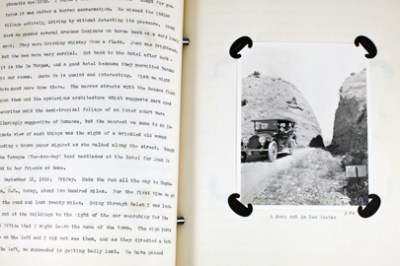
ER Burroughs "Self-Published" Book

A little more than a hundred typewritten pages with photographs and original drawings by Burroughs, it was really more of a diary of his family trip, but I suppose since he had several copies printed for family and friends it counts … if you stretch credibility a little … as self-publishing.

The frontispiece even contains the humorous, and grammatically incorrect remark: “Did Into a Book by Edgar Rice Burroughs, Inc.”

One thing about his life, however, is certain: In the summer of 1911, Edgar Rice Burroughs was 35 years old, a middle-aged father of two, and he was working in a dead end job as a manager for a pencil sharpener company.

All his previous ventures had ended poorly. A bit rowdy as a youth, his wealthy father sent him to Michigan Military Academy, in Orchard Lake, Michigan, where he actually did quite well.

He tried for an appointment to West Point, but failed the entrance exam. He went to Harvard briefly, but never finished. He eventually joined the Army, but was sent home after a few years because of a temperament that didn’t deal well with the disciplinary demands.

One low-paying job followed another, and by the time he reached that point in 1911, if one had to summarize his life in a single word, “failure” might have been a good choice.

Yet, one hundred years ago this month, convinced he could write as well or better than the awful stories he read in the pulp magazines, Edgar Rice Burroughs began writing the adventure series that would make him, and his most famous fictional creation, Tarzan of the Apes, household names around the world.

“I have often been asked how I came to write,” he once commented. “The best answer is that I needed the money. When I started I was 35 and had failed in every enterprise I had ever attempted.”

Yes, “Tarzan” is pulp fiction. It overflows with theatrical prose and political incorrectness. But Burroughs also took on the nature versus nurture debate and commented on the savageness of civilized life. He once admitted to an interviewer: “I don’t think my work is ‘literature’, I’m not fooling myself about that.” Yet he wrote some of the most beloved stories of our time. His work has been translated into more than thirty languages.

Some literary characters are able to transcend their creators and endear themselves as part of our shared culture. In doing so, they become the closest thing we have to a modern mythology.

You don’t need to understand Arthur Conan Doyle, Carlo Collodi or Mary Shelley to know their creations: Sherlock Holmes, Pinocchio and Frankenstein. That’s certainly true with the most famous creation of Edgar Rice Burroughs – Tarzan, Lord of the Apes, who first appeared in print 100 years ago.

Makes me feel good about the possibilities of my own writing. I just hope I don’t have to wait a hundred years.